Feature – Stone-throwing at jamarats, casting away bad traits

28 May 2026
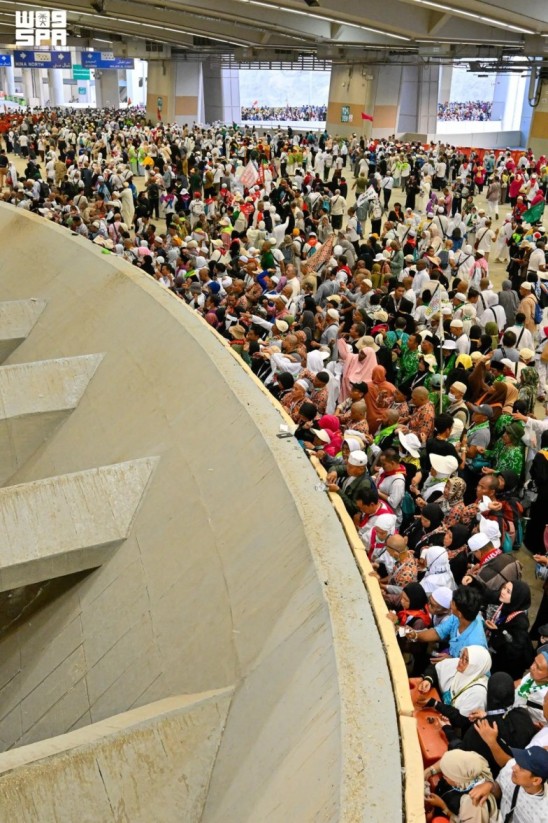
Millions of Hajj pilgrims performed the ritual of stoning the devil in Mina on the second day of Eid al-Adha (11 Dzulhijjah 1447 Hijri), or the first day of Tashreeq, on Thursday (May 28, 2026). (Saudi Press Agency)
Throwing pebbles at jamarats is more than just an ordinary ritual; it holds a long history of tests of faith, temptations from satan, and the extraordinary obedience of a chosen prophet of Allah (peace be upon him).
Bogor, W Java, (Indonesia Window) – Amidst the vast expanse of desert in the holy land of Mina, about seven kilometers from the Grand Mosque, millions of people move slowly.
The pilgrims clutch small bags containing a minimum of 49 pebbles for those performing the early Nafar (pre-pilgrimage), and 90 for those performing the Thani Nafar (pre-pilgrimage).
The early Nafar is an option for hajj pilgrims to leave Mina early before sunset on the 12th of Dhul Hijjah.
Nafar tsani is an option for hajj pilgrims to stay overnight (mabit) in Mina until the 13th of Dhul-Hijjah and complete the entire ritual of stoning the devils (ula, wustha, and aqabah jamarats).
Jamarats are three stone pillars located in the city of Mina, Saudi Arabia.
They are tired, but their eyes are full of hope.
On this day of Nahr and the days of Tashrik, they perform one of the important obligatory rituals of hajj: stoning the devils.
Throwing these pebbles is not just an ordinary ritual; behind it lies a long history of tests of faith, temptations from satan, and the extraordinary obedience of a chosen prophet of Allah subhanahu wa ta'ala.
Thousands of years before millions of people gathered in Mina, this barren desert witnessed the glorious journey of the father of the prophets, Prophet Ibrahim (peace be upon him).
One night, in the silence of the city of Hebron (Muslims call it Al-Khalil), Palestine, Ibrahim 'alaihissalam (peace be upon him) had a dream from Allah ﷻ.
In the dream, he was ordered to slaughter the son he loved so much, Prophet Ismail 'alaihissalam.
This order was not an easy matter. Ismail 'alaihissalam was the long-awaited child. The child who grew up pious and obedient. But for Ibrahim 'alaihissalam, love for Allah ﷻ was above everything.
With a trembling heart, Ibrahim 'alaihissalam conveyed the dream to Ismail 'alaihissalam with the politeness of a father.
Young Ismail did not rebel. Not crying. With complete submission, he even said: "O my father, do what Allah ﷻ has commanded you. God willing, you will find me among those who are patient."
So the two of them walked towards the slaughtering place in Mina.
In the middle of the journey, satan came to tempt him. First, satan came to Ibrahim (peace be upon him) and whispered doubts: "How could you have the heart to slaughter your own son?"
However, Ibrahim (peace be upon him) knew it was a temptation. Guided by Angel Gabriel, he picked up pebbles and threw them at satan as a sign of rejection of the evil whispers.
Satan did not give up. He went to Hajar (may Allah be pleased with her), the mother of Ismail (peace be upon him), trying to shake her heart. But Hajar (peace be upon her) remained steadfast in her faith.
Then satan again came to Ismail (peace be upon him), urging him to disobey his father, but Ismail also rejected the temptation.
It was at three different places that Ibrahim (peace be upon him) threw stones at satan. This happening marked the origin of the ritual of stoning the devil.
These three places became known as the Jamarat: the Ula Jamarat, the Wusta Jamarat, and the Aqaba Jamarat. To this day, hajj pilgrims follow that spiritual path in Mina.
When Ibrahim 'alaihissalam was about to carry out Allah's command, His power occurred. Allah ﷻ replaced Ismail 'alaihissalam with a large goat as a sacrifice.
The obedience of Ibrahim 'alaihissalam and Ismail 'alaihissalam has passed a big test. This event is a symbol of total obedience to the Almighty, courage to resist the temptations of satan, and sincerity in making sacrifices.
For this reason, every stoning is actually a symbol of human resistance to desire or lust, arrogance and whispers of evil.
Centuries later, Prophet Muhammad sallallaahu 'alaihi wassalam (ﷺ) came to bring perfect Islamic law. During the wada' hajj, the prophet ﷺ gave a direct example of the procedure for throwing of pebbles to his pals in Mina.
Prophet Muhammad ﷺ threw seven pebbles while saying takbir.
"Allah is the Greatest!" Each throw is a symbol of steadfast faith. Since then, Muslims throughout the world have followed this sunnah to this day. As Sunnah is everything that comes from the Prophet Muhammad ﷺ.
These days, Mina is filled with millions of pilgrims from all walks of life. Old, young, rich, poor, men, women, white, black, and colored, all wearing the same ihram, special white, seamless clothing that must be worn by pilgrims when they intend to perform the hajj or umrah pilgrimage.
They walk carrying pebbles toward the Jamarats. Under the scorching sun, they throw the pebbles while silently praying, fighting arrogance, banishing envy and jealousy, conquering anger, and drawing closer to Allah ﷻ.
The pebbles thrown may be small, but the meaning behind them is immense, because, truly, the jumrah (pebble throwing) is not about throwing pebbles at the visible devil. Rather, it is about people's struggle against the 'devil' within themselves.
And every year, in Mina, the great story of Prophet Ibrahim 'alaihissalam, Prophet Ismail 'alaihissalam, and Hajar radhiyallahu 'anha lives on through the millions of steps of Allah ﷻ's guests.
End
Author: Chairman of the Darul Fallah Agricultural Islamic Boarding School Foundation, in Indonesia’s Bogor District, West Java Province, Dr. Ir. H. Naufal Mahfudz, MBA, MM.
Bagikan

Komentar
Berita Terkait

COVID-19 – Indonesia receives 1.2 mln doses of ready-to-use Pfizer vaccine
Indonesia
•
03 Sep 2021
Towards rise of Indonesia’s specialty coffee
Indonesia
•
26 Dec 2020

Indonesians donate to build mosque in the Philippines’ Katubao
Indonesia
•
01 Mar 2021
Feature – Indonesian culinary delights foreign ambassadors, female figures in Brunei
Indonesia
•
13 Jun 2023

Berita Terbaru

Minister: Airports affected by Mount Anak Krakatau volcanic ash reopen
Indonesia
•
08 Sep 2026

TETO: Sudut Pandang is one of important mass media in Indonesia
Indonesia
•
06 Sep 2026
Feature – Preserving 180-year-old legacy: UIN Ar-Raniry digitizes Quranic manuscript of Acehnese scholar
Indonesia
•
29 Aug 2026

Opinion – Prophet Muhammad ﷺ and journey toward literacy, ecological awareness
Indonesia
•
27 Aug 2026