Ramadan 1447 – Hilal not sighted, Indonesian gov’t sets 1st Ramadan on February 19, 2026

17 February 2026
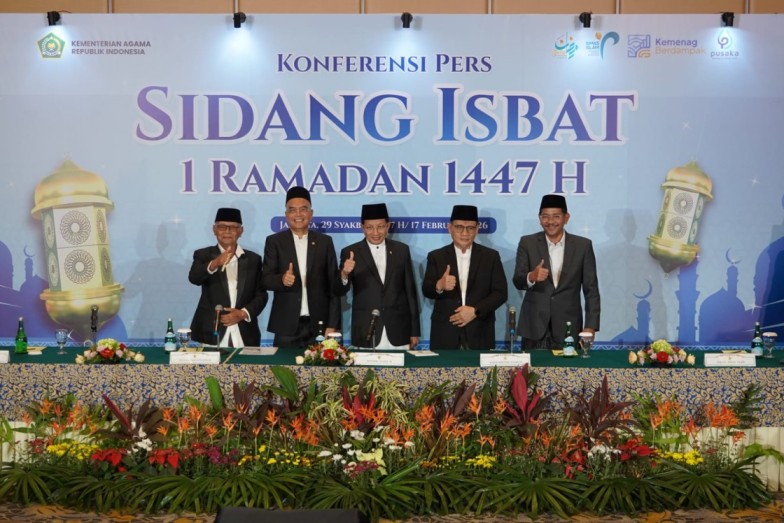
Indonesian Minister of Religious Affairs Nasaruddin Umar (center) after delivering the results of 'the isbat session' (official deliberation meeting) to determine the start of Ramadan 1447 Hijri at Hotel Borobudur, Jakarta, on Tuesday (February 17, 2026). (The Indonesian Ministry of Religious Affairs)
The first day of Ramadan 1447 Hijri falls on February 19, 2026, based on crescent moon sighting conducted at 96 locations across Indonesia.
Bogor, W Java (Indonesia Window) – The Indonesian Ministry of Religious Affairs has officially determined that 1 Ramadan 1447 Hijri/2026 will fall on Thursday, February 19, 2026.
The announcement was made by Minister of Religious Affairs Nasaruddin Umar while delivering the results of the isbat session (official deliberation meeting) to determine the start of Ramadan at Hotel Borobudur, Jakarta, on Tuesday.
“It has been agreed that 1 Ramadan 1447 Hijri falls on Thursday, February 19, 2026,” he stated.
Earlier, Minister Nasaruddin explained that Indonesia determines the beginning of the lunar month using the crescent visibility criteria of MABIMS (Ministers of Religious Affairs of Brunei Darussalam, Indonesia, Malaysia, and Singapore), which require a minimum crescent altitude of three degrees and a minimum elongation angle of 6.4 degrees.
“Based on astronomical calculations (known as hisab in Islam) , today’s crescent position across Indonesia shows an altitude ranging from minus two degrees 24 minutes 42 seconds to 0 degrees 58 minutes 47 seconds. This means the crescent does not meet the imkan rukyat (visibility) criteria and is still in a state of ghairu wujudil hilal (not yet in existence, as it remains below the horizon),” he expounded.
Nasaruddin noted that that the elongation angle was also very low, ranging from 0 degrees 56 minutes 23 seconds to 1 degree 53 minutes 36 seconds. Therefore, based on hisab calculations, the crescent data did not meet the MABIMS visibility criteria.
“Based on the hisab results and the absence of any confirmed crescent sightings from all observation points, it has been agreed that 1 Ramadan 1447 Hijri falls on Thursday, February 19, 2026,” Nasaruddin said.
The isbat session was attended by the Chair of Commission VIII of the House of Representatives (locally known as its abbreviation DPR RI), the Chairman of the Indonesian Ulema Council (MUI), echelon I and II officials of the Ministry of Religious Affairs, leaders or representatives of Islamic organizations, as well as experts in Islamic astronomy from State Islamic Universities (UIN) and State Islamic Institutes (IAIN).
Representatives from the Meteorology, Climatology, and Geophysics Agency (locally known as its abbreviation BMKG), the National Research and Innovation Agency (known as BRIN), the Geospatial Information Agency (BIG), Jakarta Planetarium, and members of the Ministry’s Hisab Rukyat Team were also present.
The isbat session began with a seminar broadcast live through the social media channels of the Directorate General of Islamic Community Guidance (Ditjen Bimas Islam).
The seminar presented the principles and methods for determining the start of the lunar month, followed by a panel discussion with speakers discussing hisab, rukyat (moon sighting), and Islamic astronomy from various perspectives.
The ministry then officially determined the beginning of Ramadan through the isbat session.
“During the session, we deliberated openly with experts in astronomy, members of parliament, MUI representatives, and representatives of Islamic organizations. The deliberation referred to the results of hisab and rukyat conducted by the Ministry’s Hisab Rukyat Team and Islamic organizations, and was confirmed by officers at no fewer than 96 observation points across Indonesia,” Minister Nasaruddin pointed out.
He expressed hope that the government’s decision would allow Muslims across Indonesia to begin fasting simultaneously.
“May this serve as a symbol of unity among Indonesian Muslims and reflect our solidarity as fellow citizens,” the minister said.
“If there are some Muslims who observe Ramadan based on different beliefs or methods, we urge that such differences should not lead to disunion. Let us regard differences as a beautiful richness. Indonesia has long experienced differences while remaining united,” Minister Nasaruddin reminded.
Reporting by Indonesia Window
Bagikan

Komentar
Berita Terkait
Indonesia to build 600 megawatt bioenergy plants by 2030
Indonesia
•
29 Jan 2022
Feature – Taiwan mission teaches Karawang primary school students food technology
Indonesia
•
28 Oct 2024

How Indonesian students win respect at Saudi universities, according to Umm Al-Qura’s CEO
Indonesia
•
01 Aug 2026

COVID-19 – Foreigners to Indonesia must show vaccination cards
Indonesia
•
04 Jul 2021


Berita Terbaru

Minister: Airports affected by Mount Anak Krakatau volcanic ash reopen
Indonesia
•
08 Sep 2026

TETO: Sudut Pandang is one of important mass media in Indonesia
Indonesia
•
06 Sep 2026
Feature – Preserving 180-year-old legacy: UIN Ar-Raniry digitizes Quranic manuscript of Acehnese scholar
Indonesia
•
29 Aug 2026

Opinion – Prophet Muhammad ﷺ and journey toward literacy, ecological awareness
Indonesia
•
27 Aug 2026