Islamic scientific study – The big goal of Ramadan fasting is to train emotional intelligence and patience

16 February 2026
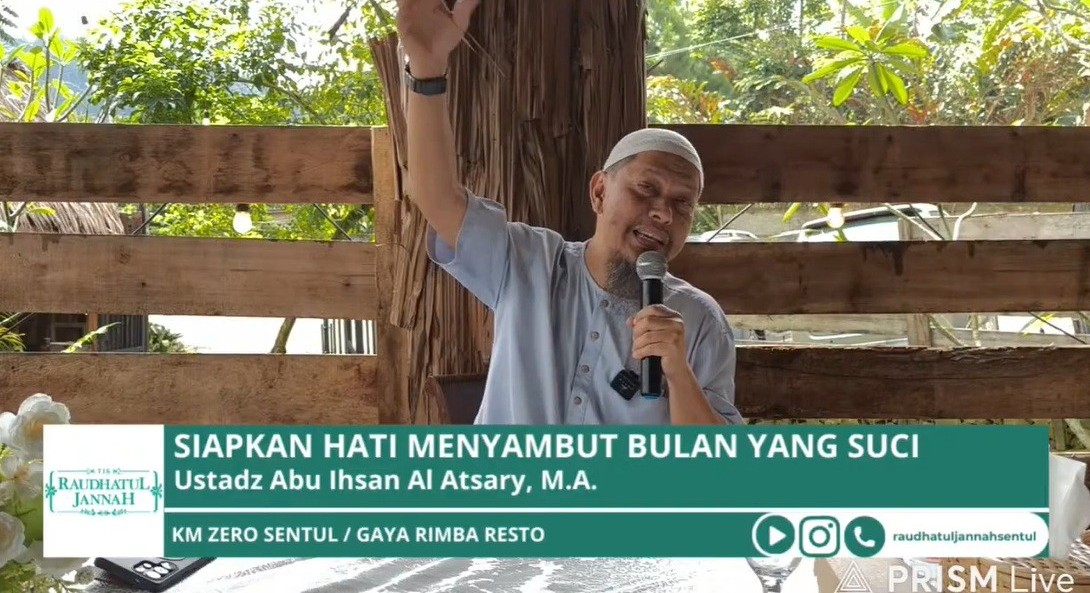
The big goal of Ramdan fasting is to train emotional intelligence, which in Sharia is patience.
Bogor, West Jawa (Indonesia Window) – The big goal of the Ramadan fasting is to train emotional intelligence, the syar'i language of which is patience, said Ustadz Abu Ihsan Al Atsari, M.A., in a scientific study under the theme 'Prepare Your Heart to Welcome the Holy Month', which was held at Resto KM Zero, in Indonesia’s Sentul area, Bogor district, West Java province, recently ahead of Ramadan.
Ust. Abu Ihsan explained that Ramadan is a month to train Muslims to restrain their desires, including restraining their emotions.
Prophet Muhammad ﷺ said: If someone is fasting, then don't say evil things and don't do mischievous things. If someone attacks him or her with words or makes him fight, then say, 'Indeed I am fasting'," Ust. Abu Ihsan said.
"Note, the Prophet ﷺ didn't say 'I'm fasting,' but rather demonstrated his character. This means that a fasting person is someone who can control their emotions—not just during Ramadan, but as a character trait within themselves," he said.
If you want to understand patience simply, it means: don't get angry, Shaikh Abu Ihsan said, adding that the Prophet ﷺ was asked repeatedly for advice. He answered, 'Don't get angry.' He repeated it three times. Without commas. Without exceptions.
"Why? Because if there are exceptions, we just remember the exceptions. We have a thousand reasons to be angry, but it's very difficult to find reasons not to be angry," he explained, adding that anger is often considered normal, even legal. "Yet its impact is extraordinarily unexpected".
Anger in Children's Education
On the occasion, the Shaikh told the audience that he had written a book entitled ‘Mendidik Anak Tanpa Amarah’ or ‘Educating Children Without Anger.’
"I call this the zero point of education. Education must start from the absence of anger," he said.
Recently, there have been many tragic cases: children killing their parents (parricide), or parents hurting their children. One factor that often arises is poor parenting—especially excessive anger, he noted.
According to him, the first reason parents become easily angered is fatigue.
“Tired persons get angry easily. Mothers understand this best. Household chores, childcare, school pick-ups, everything accumulates. When we're tired, our emotions become high," he added
The Prophet (peace be upon him) helped his wife at home. He didn't burden her with everything, he cited.
The second reason is that anger is congenital or inherited. In some families, anger becomes a tradition passed down from generation to generation. "Unconsciously, we imitate our parents' ways. Memories of being scolded are stored in our subconscious and resurface when we become parents. If we want to be safe, we must break that tradition of anger in our families," he advised.
The third, being overly obsessed with results. "We want our children to be perfect, compared to other people's children. Ultimately, we lack the patience to go through the process. Yet, the results are not in our hands, but in the hands of Allah ﷻ. What is our responsibility is the process and effort," he said.
Don't say, "I failed as a parent." Say, "I was wrong." So we can improve. It's not the one who failed who was wrong, but the one who didn't do anything, the Shaikh advised.
Anger is the root cause of many tragedies. There was a case of a father throwing his child to death just because of a momentary fit of anger. How costly is that anger, Ust. Abu Ihsan reminded us, adding, "That's why the Prophet ﷺ said: 'Don't be angry.' Period".
He pointed out that Ramadan is the best time to practice emotional control. The atmosphere is supportive. Mosques are crowded, people compete in good deeds. "If Satan is chained during Ramadan, and we still lose to our own emotions, what if Satan isn't chained?" he said.
So, use Ramadan to hone our emotional intelligence. Don't just endure hunger and thirst, but also endure anger, because the measure of success in Ramadan is not just how many times we complete reading the Quran, but how much more patient we become, he told the audience.
"May Allah ﷻ make us His servants who are grateful, who are patient, and who are able to control our emotions. Wallahu a'lam bish-shawab (And Allah knows best," Ustadz Abu Ihsan Al Atsary said.
Reporting by Indonesia Window
Bagikan

Komentar
Berita Terkait
President: Inclusivity becomes Indonesia's top priority at G20
Indonesia
•
23 Sep 2021

Indonesia becomes German automotive hub of Mercedes Benz exports
Indonesia
•
29 Nov 2021

IRI, PJMI collaborate to support tropical forest protection, climate action
Indonesia
•
17 Feb 2025

Indonesia appoints honorary consul in S Africa’s Durban
Indonesia
•
07 Oct 2020


Berita Terbaru

Minister: Airports affected by Mount Anak Krakatau volcanic ash reopen
Indonesia
•
08 Sep 2026

TETO: Sudut Pandang is one of important mass media in Indonesia
Indonesia
•
06 Sep 2026
Feature – Preserving 180-year-old legacy: UIN Ar-Raniry digitizes Quranic manuscript of Acehnese scholar
Indonesia
•
29 Aug 2026

Opinion – Prophet Muhammad ﷺ and journey toward literacy, ecological awareness
Indonesia
•
27 Aug 2026