News Focus – Why does Javan rhino need second habitat? Indonesian researchers explain

19 November 2026
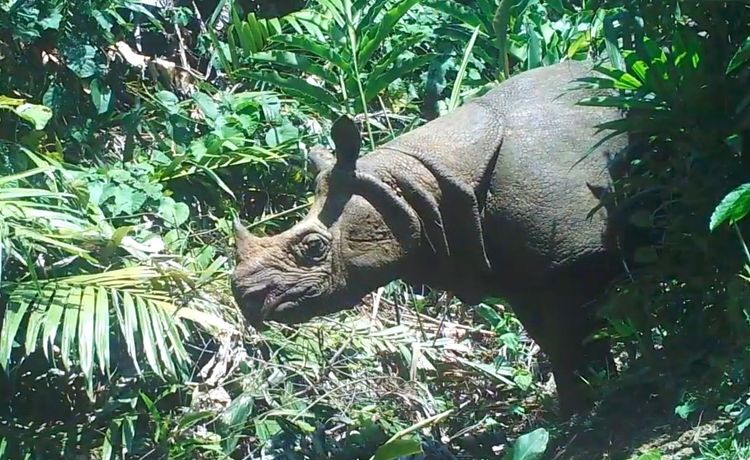
Javan rhinoceros (Rhinoceros sondaicus) in the Ujung Kulon National Park area, Indonesia’s Pandeglang District, West Java Province. (The Ministry of Forestry of the Republic of Indonesia)
Bogor, West Java (Indonesia Window) – The proposed relocation of Javan rhinos from their natural habitat in Ujung Kulon, Indonesia’s Pandeglang District, Banten Province, to Alas Purwo National Park in Banyuwangi District, East Java Province, has sparked considerable criticism among the public.
Over nearly two decades, various studies on establishing a second habitat for the Javan rhinoceros (Rhinoceros sondaicus) have provided important lessons.
Efforts to establish a new population involve more than simply assessing an area's ecological suitability; they also require management readiness and comprehensive scientific consideration.
This was explained by Prof. Hendra Gunawan, a researcher at the Research Center for Ecology of the National Research and Innovation Agency (BRIN), in an interview on Tuesday (November 17), as quoted from BRIN's website on Wednesday.
According to him, a second habitat is not merely a program to relocate animals from one area to another.
"The main objective is to establish an additional population to reduce the risk of Javan rhino extinction through a conservation strategy known as metapopulation," he explained.
Currently, the entire natural population of Javan rhinos is concentrated in Indonesia’s Ujung Kulon National Park. This situation creates vulnerability in the event of a large-scale natural disaster, disease outbreak, forest fire, or other ecological disturbance that could affect the entire population simultaneously.
Developing populations in other habitats is one strategy to strengthen the species' long-term resilience without reducing the priority given to protecting its natural habitat in Ujung Kulon.
Under the metapopulation concept, Ujung Kulon could serve as the main population (mainland), while additional populations in other habitats would function as islands.
Several populations managed in an integrated manner are expected to reduce the species' dependence on a single area for its survival.
Genetic connectivity between populations must also be considered and can be managed through conservation interventions planned on the basis of genetic and demographic studies.
"Therefore, the more appropriate term is the development of an additional population through a translocation conservation program, rather than relocating the entire population or moving all the animals at once," Prof. Hendra explained.
Second-Habitat Studies
Hendra pointed out that the idea of developing a second habitat for Javan rhinos is not new to Indonesia's national conservation agenda.
The strategy was included in the Strategy and Action Plan for the Conservation of Rhinos in Indonesia 2007–2017.
He himself has been involved in several second-habitat feasibility studies, particularly those assessing socioeconomic and sociocultural aspects, public perceptions, and community acceptance in areas surrounding potential locations.
In 2009, Prof. Hendra said, a study was conducted under the Second Habitat Assessment for the Javan Rhinoceros program. The research covered the Gunung Honje Forest Complex in Ujung Kulon National Park and the area around Citorek in Gunung Halimun-Salak National Park.
The study found that public support for the proposed development of a second habitat near Mount Honje reached 46 percent, while support in the area around Mount Halimun stood at only 23 percent. Meanwhile, opposition reached 24 percent and 54 percent, respectively.
According to him, these findings show that an area's ecological suitability does not necessarily translate into sufficient public acceptance.
Local economic conditions, dependence on forest resources, land ownership and tenure status, and public perceptions of national park management also influence community support.
A subsequent study was conducted in 2015 through a research program by the World Wide Fund for Nature (WWF) in Cikepuh Wildlife Reserve, Sukabumi District, West Java Province, and the Cikeusik forest area under the management of the Banten Forest Management Unit.
The study involved 540 respondents from 18 villages and 54 key respondents representing local government institutions. The results showed that public acceptance in communities surrounding Cikepuh Wildlife Reserve reached 85.8 percent.
Meanwhile, acceptance among communities surrounding the Cikeusik forest area stood at only around 24 percent, with 55 percent of respondents expressing a neutral position.
One interesting finding concerned the perception among some community members that the Javan rhino was an important symbol of Banten Province.
Some respondents around Cikeusik objected to the idea of relocating an animal that had long been a source of regional pride to another province.
In contrast, communities around Cikepuh expressed enthusiasm, hoping that the presence of Javan rhinos would strengthen forest protection, create economic opportunities and jobs, and promote ecotourism.
"These findings reinforce the fact that public support is one of the essential prerequisites for the successful development of a second habitat," he said.
Suitability of Forest Areas
According to Prof. Hendra, selecting a second habitat must be done carefully because not every large, green forest area with high biodiversity is automatically suitable for Javan rhinos.
Government studies have established 13 important criteria, including the historical distribution of Javan rhinos, habitat suitability, year-round water availability, conservation-area status, area size, management capacity, external support, local government commitment, and potential for education and ecotourism.
Beyond these criteria, current assessments must also cover ecological carrying capacity, natural food availability, wallowing sites, roaming areas, animal health conditions, disease risks, site security, and the potential for interactions with humans and other wildlife.
Sociocultural considerations must also be treated as an important part of the planning process. Communities living around potential habitats must be involved from the outset through communication and consultation to ensure that wildlife conservation objectives are aligned with community interests.
"A good conservation program should not position wildlife interests and community interests as two opposing priorities. Instead, both should be developed in synergy," Prof. Hendra explained.
Alas Purwo National Park, in the context of establishing a second habitat for Javan rhinos, requires further in-depth assessment, he added.
"Alas Purwo needs to undergo a dedicated assessment using relevant criteria and the latest developments in conservation methodologies. The results should also be compared objectively with those of other potential locations," he pointed out.
Prof. Hendra also emphasized that the exploration of Alas Purwo as a potential second habitat still requires further scientific investigation.
To date, no decision has been made regarding the final location, the number of individuals to be relocated, the relocation method, or the implementation timeline.
Protecting the Javan rhino population in Ujung Kulon must remain the priority while efforts to explore a second habitat continue alongside it.
Reporting by Indonesia Window
Bagikan

Komentar
Berita Terkait
Indonesia’s March 2023 inflation under control
Indonesia
•
05 Apr 2023

Elon Musk to visit Indonesia in November
Indonesia
•
15 May 2022

COVID-19 – Indonesia receives 500,000 doses of AstraZeneca from Australia
Indonesia
•
03 Sep 2021
News Focus - Betawi ethnic community anticipates future’s status of Jakarta as global, business city
Indonesia
•
07 Jun 2023


Berita Terbaru
News Focus – The White Spot hosts 'Bazaar Raya Collections': A Sustainable Business Approach for the Muslim Fashion Industry in Indonesia
Indonesia
•
18 Nov 2026

Feature – Indonesian experts proudly involved in Taiwan’s semiconductor industry
Indonesia
•
19 Nov 2026
At ASEAN-US Summit, Trump praises Indonesia’s leadership and cooperation
Indonesia
•
18 Nov 2026
At ASEAN–Japan Summit, Indonesian president calls for concrete action to implement strategic partnership
Indonesia
•
17 Nov 2026