News Focus – Productive Waqf Forum and OIC Youth Indonesia encourage talent collaboration and sustainable innovation

15 July 2026
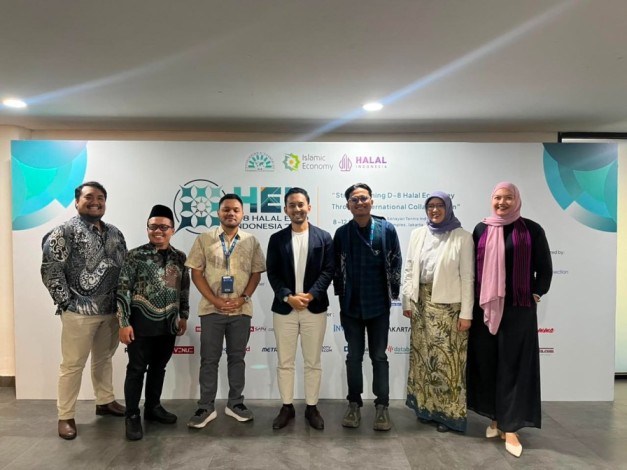
The speakers along with representatives from the Productive Waqf Forum, OIC Youth Indonesia, Pijar Foundation, MOSAIC, and Purpose at the D-8 Halal Expo Indonesia 2026. (Photo: doc. OIC Youth Indonesia)
The Productive Waqf Forum, OIC Youth Indonesia, Pijar Foundation, through the Muda Town Hall, MOSAIC, and Purpose, strengthened their commitment to fostering cross-sector collaboration and expanding the use of talent, innovation, and faith-based finance for shared prosperity.
Jakarta (Indonesia Window) – The Productive Waqf Forum and OIC Youth Indonesia, together with Pijar Foundation, held a session titled ‘Unlocking New Drivers of Development: Talent, Sustainable Innovation, and Faith-Based Finance for Shared Prosperity’.
The session was organized through an initiative by Muda Town Hall, MOSAIC, and Purpose as part of the D-8 Halal Expo Indonesia 2026 series.
The D-8 Halal Expo Indonesia 2026 was held from July 8–12, 2026, by the Ministry of Foreign Affairs of the Republic of Indonesia, the National Committee for Islamic Economics and Finance (known as KNEKS), the Halal Product Guarantee Agency (known as BPJPH), and the Indonesian Chamber of Commerce and Industry (KADIN Indonesia).
The session highlighted the importance of connecting talent development, sustainable innovation, and religious-based finance, including zakat and productive waqf, to provide practical, inclusive, and sustainable development solutions amidst global change.
The discussion opened with a contextual introduction themed ‘New Drivers of Development in an Era of Global Shifts’. Participants were invited to reflect on a central question: when traditional development approaches are no longer fully adequate to address increasingly complex and interconnected challenges, how should new approaches be formulated for a shared future?
In her introduction, Astrid Nadya Rizqita, President of the OIC Youth Indonesia, highlighted the relevance of the D-8 as a platform for economic cooperation among developing countries.
D-8 member countries have large and dynamic young populations, but this demographic potential can only deliver tangible benefits if supported by investments in capacity building, access to opportunities, innovation, and youth participation in the development process.
The session then continued with a fireside chat and panel discussion featuring Greget Kalla Buana, Islamic Finance Specialist and Influencer; Rayan Asa Luminaries, Chair of the Productive Waqf Forum; and Ranitya Nurlita, Founder of WasteHub and recipient of the MUDA30 2025 award. The discussion was moderated by Astrid Nadya Rizqita.
Driving a circular economy through community ownership, Ranitya Nurlita emphasized the need to shift from a linear economic pattern—take, use, and dispose—to a circular economy that maintains resources' value for as long as possible.
In the context of waste management, this change requires source segregation, community participation, and an ecosystem that allows waste to be recycled into resources.
According to her, implementing a circular economy cannot be achieved through a uniform approach. Each program needs to understand the social, economic, cultural, and environmental conditions of the community as a whole.
Technical terms and concepts also need to be translated into language relevant to everyday life so that the community can understand, adopt, and own the solutions.
Ranitya also emphasized the importance of a pentahelix collaboration model, involving the government, the private sector, academia, communities, and the media.
The involvement of various stakeholders is necessary so that programs do not remain short-term interventions but develop into movements with local ownership, measurable results, and social and financial sustainability.
Programs also need to be designed inclusively, including by involving women, people with disabilities, and community groups that often lack equal access.
Expanding on the role of waqf as a development instrument, Rayan Asa Luminaries explained that the public's understanding of waqf is still often limited to the concept of the "3Ms": makbarah, mosque, and madrasah.
While all three have important roles, the potential of waqf can be further developed through cash waqf and productive asset management, hence the fourth M, Money.
Productive waqf allows the principal value of assets to be maintained and managed to generate sustainable benefits.
With proper governance, this instrument can support various development needs, from education and business empowerment to environmental conservation and the provision of renewable energy.
One example discussed was the use of waqf to support the installation of solar panels on mosques.
This approach demonstrates that waqf is not only relevant for conventional religious infrastructure development but can also help improve energy access, support post-disaster recovery, and contribute to the environmental agenda.
Rayan also emphasized that participation in zakat and waqf needs to begin with personal action.
According to him, waqf is not enough to simply talk about or promote; its impact will emerge when the community begins to practice it and encourage others through example.
Building trust and expanding impact financing, Greget Kalla Buana highlighted the enormous potential of zakat and waqf that has not yet been fully realized.
The gap between potential and actual collection is influenced by, among other factors, low Islamic financial literacy and limited public trust in the management of social funds.
Therefore, transparency, accountability, professional governance, and impact measurement are crucial.
The public needs to know how funds are collected, managed, distributed, and how they produce demonstrable change.
Greget also advocates the use of a blended finance approach, which combines Islamic social finance instruments such as zakat and waqf with commercial funds, corporate social responsibility programs, philanthropy, and government support.
This approach can expand the scale of financing to address challenges such as poverty, climate change, access to healthcare, economic empowerment, and rural electrification.
Cross-sector collaboration also requires a common language. Governments, investors, philanthropic institutions, businesses, and communities may have different goals and indicators of success.
Frameworks such as the Sustainable Development Goals (SDGs) and environmental, social, and governance (ESG) principles can provide a meeting point for aligning financial, social, and environmental goals.
From Potential to Collective Action
The discussion emphasized that current development challenges cannot be addressed through a business-as-usual approach.
Talent development, sustainable innovation, and faith-based finance need to be brought together within a collaborative ecosystem.
The younger generation has a crucial role to play in this ecosystem—not just as beneficiaries, but as innovators, community mobilizers, entrepreneurs, social investors, and future policymakers.
However, the contribution of the younger generation requires participation, capacity building, mentoring, access to networks, and adequate financial support.
The speakers also emphasized that religious values can provide a moral foundation for sustainable development.
Religious-based finance is not merely positioned as an implementation of religious obligations, but also as a means to provide benefits, strengthen social solidarity, and build long-term commitment to people and the environment.
At the conclusion of the session, Ir. H. Putu Rahwidhiyasa, MBA, Director of Sharia Business and Entrepreneurship at the National Committee for Sharia Economics and Finance (KNEKS), representing the organizers of the D-8 Halal Expo Indonesia 2026, presented tokens of appreciation to the speakers and moderator.
Through this session, the Productive Waqf Forum, OIC Youth Indonesia, Pijar Foundation through Muda Town Hall, MOSAIC, and Purpose strengthened their commitment to fostering cross-sector collaboration and expanding the utilization of talent, innovation, and religious-based finance for shared prosperity.
Reporting by Indonesia Window
Bagikan

Komentar
Berita Terkait
Indonesia and France strengthen early childhood education program
Indonesia
•
23 Jun 2025

Over 340 thousand Indonesians perform umrah in three months
Indonesia
•
07 Dec 2019
Indonesia, Romania explore enhanced defense cooperation
Indonesia
•
28 May 2021
News Focus – Halal products to become world's favorites in 2024
Indonesia
•
26 Nov 2023
Berita Terbaru
Minister: Airports affected by Mount Anak Krakatau volcanic ash reopen
Indonesia
•
08 Sep 2026
TETO: Sudut Pandang is one of important mass media in Indonesia
Indonesia
•
06 Sep 2026
Feature – Preserving 180-year-old legacy: UIN Ar-Raniry digitizes Quranic manuscript of Acehnese scholar
Indonesia
•
29 Aug 2026
Opinion – Prophet Muhammad ﷺ and journey toward literacy, ecological awareness
Indonesia
•
27 Aug 2026