News Focus – FOKSI plays role as communication channel for wildlife conservation in Indonesia

24 August 2026
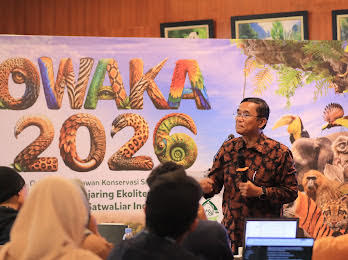
Prof. Jatna Supriatna, Ph.D., professor at the Department of Biology, Faculty of Mathematics and Natural Sciences, University of Indonesia, is one of the speakers during the Conservation Journalists Orientation (OWAKA) in Indonesia’s Bogor District, West Java Province, on Friday (Aug. 21, 2026). (PHOTO: HO-Humas TSI Group)
OWAKA is a specialized training and education program for journalists to delve into environmental preservation issues and wildlife protection, an initiative historically spearheaded by The Indonesian Wildlife Conservation Forum (FOKSI)
Bogor, West Java (Indonesia Window) – The Indonesian Wildlife Conservation Forum (FOKSI) plays a significant role to act as a primary communication channel for wildlife conservation in the country in the future.
"This Conservation Journalists Orientation (OWAKA) held by FOKSI is important so that in the future, we hope it would become an independent, strong, and self-reliant organization," President Director of Taman Safari Indonesia (TSI/Indonesia Safari Park) Group Aswin Sumampau, said at Rumah Dua, Indonesia’s Puncak area, Bogor District, West Java Province, on Friday (Aug. 21) afternoon.
According to Aswin, it is such a forum for discussion and a communication mouthpiece for (Indonesian wildlife) conservation as well.
FOKSI is a non-profit organization founded on February 5, 1998, born out of concern over environmental degradation and the preservation of Indonesia's endemic species.
Teguh Laksana, one of the FOKSI founders, said journalists came together to join forces with academicians, business leaders, researchers, bureaucrats, animal lovers (hobbyists), and environmentalists to carry out a joint conservation mission.
He said OWAKA is a specialized training and education program for journalists to delve into environmental preservation issues and wildlife protection, an initiative historically spearheaded by FOKSI.
After more than 10 years of inactivity due to various factors, including the COVID-19 pandemic, he said further OWAKA has been revived to continue wildlife conservation agendas and issues by inviting young journalists.
Teguh and another co- founder of FOKSI Tony Sumampau presented their historical testimonials about the forum during the orientation event attended by around 30 journalists from different media outlets.
Aswin pointed out that amidst rapidly changing dynamics, many things might no longer be relevant, and even regulations often fell behind the times.
"However, what remains certain is that some conditions have not changed, such as the trend of declining forest functions, species decline, and the threat of extinction facing rare animal species in Indonesia," he said.
Because of this, he encouraged the forum to evolve toward what he coined ‘FOKSI 2.0’—a modern version relevant to ongoing changes.
"Namely, to be part of the solution to real problems that are more or less the same as they were 30–40 years ago. To that end, I encourage FOKSI to rediscover its core identity, a sharp vision, and strategies that are relevant, realistic, and solution-oriented to be executed together," he stated.
For FOKSI’s future path, he suggested that the forum position itself as a pillar of conservation education for the Indonesian nation.
"So, I feel FOKSI shouldn't take a stance where many other parties are already working. Perhaps FOKSI can focus on providing conservation education to elementary school children up to university students," he said, adding that they could also promote educational and positive articles on the importance of conservation to the general public.
In closing his remarks, Aswin emphasized that OWAKA 2026 is important, and his team stands ready to provide full support and assistance.
This includes mentoring, providing experts in legal matters, conservation, and related fields derived from TSI's 45 years of experience in the real sector and conservation.
"As well as international networks, and even government links. Essentially, we are ready to support FOKSI to move forward," Aswin said.
Meanwhile, the first speaker of the three-day event (Aug. 21–23), professor at the Department of Biology, FMIPA UI, Prof. Jatna Supriatna, Ph.D.—discussed issues surrounding traditional versus modern conservation.
He explained that under the traditional conservation view, the concept is to keep animals away from humans, whereas modern conservation relies on research integration using scientific methodologies and research-based approaches.
Other three speakers also attended to share their views during the event.
Furthermore, FOKSI advisor and co-founder Tony Sumampau provided an introduction regarding the long journey of wildlife conservation in Indonesia.
One notable example was the successful conservation of the Bali myna (locally knwn as curik bali), whose wild population in West Bali National Park had fallen below five birds.
Through collaboration via the Bali Myna Conservation Association (locally known as its abbreviation APCB), they successfully bred and released them back into the wild, where the population has now reached around 2,000.
Taman Safari Indonesia's Journey
Taman Safari Indonesia (TSI) is a world-class recreational theme park and conservation site located in six locations and four resorts across Indonesia.
It boasts more than 10,000 animals across 400 species and attracts over six million visitors annually. Since 1980, TSI has played an important role in saving, rehabilitating, and releasing thousands of animals back into the wild.
As a result, it has become a prominent global conservation organization for Indonesia’s endemic wildlife and endangered species. TSI has earned a number of international certifications and 20 national awards for its conservation and recreational efforts.
The journey of TSI began with the opening of its first wildlife conservation area,
The Great Taman Safari Bogor, in Cisarua Sub District, Bogor District, in April 1986. Over the years, it expanded its footprint by establishing The Grand Taman Safari Indonesia Prigen in Pasuruan District, East Java Province, in December 1997.
The success of these two conservation areas inspired Taman Safari Indonesia to create additional sites, including The Amazing Taman Safari Bali, The Funtastic Beach Safari in Batang District, Central Java Province, Jakarta Aquarium & Safari, Solo Safari, and the latest addition, Marine Safari Bali, Varuna Bali & Enchanting Valley Bogor.
TSI also oversees several tourism-related businesses, such as Royal Safari Garden, Safari Resort, Baobab Safari Resort, Mara River Safari Lodge, and Safari Wonders.
Taman Safari Indonesia’s vision is to be an educational and research-based wildlife conservation and tourism destination.
Reporting by Indonesia Window
Bagikan

Komentar
Berita Terkait
Indonesia prioritizes comprehensive waste management strategy
Indonesia
•
13 Mar 2025
Denpasar Immigration Office deports Russian and Australian
Indonesia
•
15 Mar 2023

COVID-19 – Indonesia receives fourth phase of Sinovac vaccine raw materials
Indonesia
•
02 Feb 2021
COVID-19 – Indonesia imposes emergency public restrictions in Java, Bali by July 3
Indonesia
•
01 Jul 2021


Berita Terbaru
AICIS+ 2026 engages both public universities and Islamic boarding schools
Indonesia
•
23 Aug 2026
MIKTA pays tribute to Indonesian peacekeepers in Sentul area, West Java
Indonesia
•
22 Aug 2026
Indonesia, University of Melbourne pave way for ‘madrasah’ students to world-class campuses
Indonesia
•
21 Aug 2026
Indonesia’s Religious Affairs Ministry strengthens globalization of Islamic higher education
Indonesia
•
19 Aug 2026