Indonesia launches unified data on zakat, infaq, and sadaqah

06 August 2026
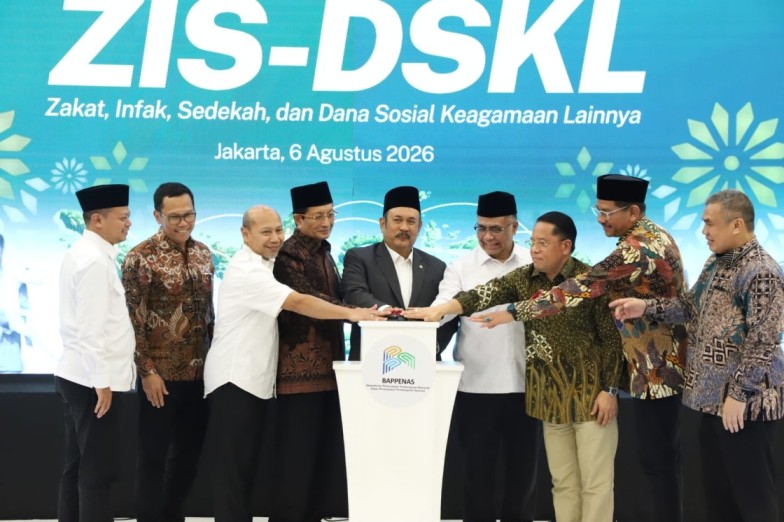
The Indonesian Ministry of Religious Affairs, and the Ministry of National Development Planning launched the Single Data on Zakat, Infaq, Sadaqah, and Other Religious Social Funds (ZIS-DSKL) in Jakarta on Thursday (August 6, 2026). (The Ministry of Religious Affairs of the Republic of Indonesia)
The integration of data regarding zakat (obligatory alms), infaq (voluntary contributions), sedekah (charity), and other religious social funds (collectively known as ZIS-DSKL) aims to help managing institutions gain a more comprehensive understanding of beneficiaries.
Jakarta (Indonesia Window) – The Indonesian Ministry of Religious Affairs, in collaboration with the Ministry of National Development Planning, has launched a unified data system for ‘zakat’, ‘infak’, ‘sedekah’, and Other Religious Social Funds (known as ZIS-DSKL).
Minister of Religious Affairs Nasaruddin Umar stated that data integration is necessary to prevent the distribution of community funds from overlapping—where the same recipients receive aid repeatedly—while other needy members of the public remain unassisted.
"If we improve this data, [we can ensure that] if someone has already received aid from the central BAZNAS (National Zakat Agency), they do not need to receive it again from a regional BAZNAS. If they have received it from BAZNAS, they do not need to receive it again from the Ministry of Social Affairs," the minister said here on Thursday (Aug. 6).
According to the Minister, the issue of accurate targeting is important because aid for the community comes from various institutions.
Without integrated data, there is a possibility that an individual could receive aid from multiple sources simultaneously, while other community members have yet to receive any assistance, he noted on the Ministry of Religious Affairs' website.
The ZIS-DSKL unified data system was developed to address this issue by integrating data on mustahik (zakat recipients) with the National Socio-Economic Single Data (known as the abbreviation DTSEN).
The data utilized includes not only recipient identities but also demographic information, addresses, welfare status, and the history of government aid received.
Pungkas Bahjuri Ali, Deputy for Human Development and Culture at the Ministry of National Development Planning, explained that the platform combines core data from the DTSEN with operational data from aid-providing institutions.
This integration enables the identification and verification of prospective mustahik to be conducted using a more comprehensive dataset.
"This platform serves as a means to integrate mustahik data with the DTSEN," the minister stated. The system was developed to integrate data on religious social fund beneficiaries with the National Socio-Economic Single Data (DTSEN).
This integration aims to assist ZIS-DSKL (zakat, infaq, sadaqah, and Religious Social-Commercial Funds) management institutions in gaining a more comprehensive understanding of beneficiaries, including their welfare status and history of assistance received from various government programs and religious social institutions.
Under this mechanism, data on mustahik (zakat recipients) is first integrated with operational data containing details such as the assisting institution, the amount of aid, and the transaction date.
This data then undergoes a DTSEN verification process to identify existing assistance status and complete the beneficiary's profile.
The result of the process is in the form of a mustahik profile that includes a history of aid distribution interventions from BAZNAS (the National Zakat Agency) and/or Zakat Management Institutions.
Consequently, ZIS-DSKL management institutions possess information that can serve as a basis for determining distribution targets.
The ZIS-DSKL Single Data initiative is not limited to a single institution. Based on the outlined mechanism, the platform is accessible to BAZNAS (at national, provincial, and district/city levels) and LAZs across Indonesia.
Data management involves a number of ministries and agencies, including the Ministry of Religious Affairs, the Ministry of National Development Planning, the Coordinating Ministry for Community Empowerment, the Ministry of Social Affairs, the Ministry of Communication and Digital Affairs, BAZNAS, and Statistics Indonesia (known as BPS).
Benefits of ZIS-DSKL Single Data
In practical terms, this integration offers several key benefits:
Helps ensure aid reaches the right targets. Information regarding socio-economic conditions and assistance history helps identify individuals or communities requiring intervention.
Reduces the potential for aid duplication. By reviewing assistance history, ZIS-DSKL management institutions can determine whether a would-be recipient has already received aid from other sources.
Supports data-driven program planning. Integrated data can be used to map needs and design empowerment programs tailored to the beneficiaries' specific conditions.
Strengthens transparency and accountability in the management of religious social funds. Distribution is recorded not only based on the monetary value of the aid but can also be linked to recipient profiles and the history of interventions received.
In the broader context, the integration of ZIS-DSKL with DTSEN is expected to strengthen collaboration between the government and religious social fund management institutions regarding development programs—including education, healthcare, economic empowerment, and poverty alleviation.
The ZIS-DSKL One Data platform showcased during the launch presentation can be accessed via the Ministry of Religious Affairs' SIMZAT (Zakat Management Information System) at simzat.kemenag.go.id.
The site is a Ministry of Religious Affairs platform that also serves various functions related to zakat management and information.
Editing by Indonesia Window
Bagikan

Komentar
Berita Terkait

Muslims expected not to be seasonal entrepreneurs during Ramadan
Indonesia
•
19 Mar 2023
Indonesia has FTA negotiation with EAEU completed soon
Indonesia
•
27 Jan 2023

Beirut’s Saint Joseph University takes part in Indonesia’s Ship Tour
Indonesia
•
07 Mar 2023

Indonesia, Korea agree to develop critical minerals
Indonesia
•
23 Feb 2022


Berita Terbaru

Profile – Indonesian Islamic boarding school student discovers security flaws in systems of NASA, University of Melbourne
Indonesia
•
17 Sep 2026
Suahasil Nazara Indonesia’s new finance minister, replacing Purbaya
Indonesia
•
14 Sep 2026
Indonesia’s professor: ‘Dhikr’ in Islam not merely verbal utterance, but matter of awareness and conduct
Indonesia
•
14 Sep 2026

Minister: Airports affected by Mount Anak Krakatau volcanic ash reopen
Indonesia
•
08 Sep 2026