Feature - Pangrango Ancient Crater Expedition reveals biodiversity and geological richness at altitudes exceeding 2,000 meters

11 October 2026
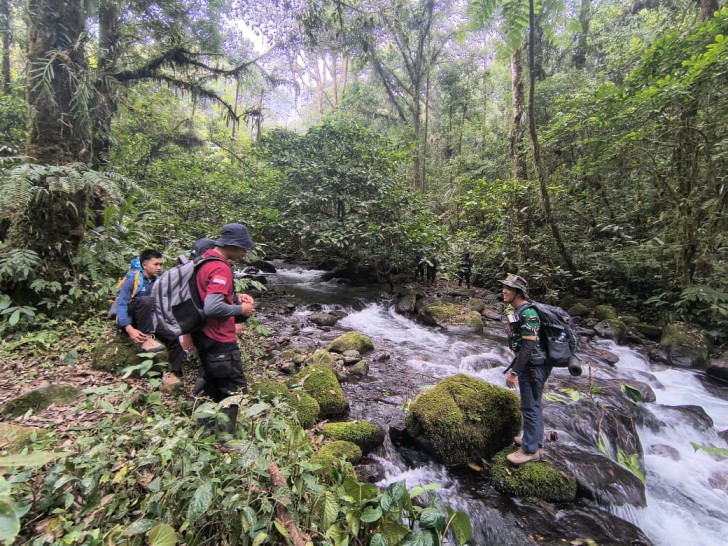
This undated photo shows Pangrango Ancient Crater Expedition team members explored the nature of the area. (Photo: Special)
Unlike the crater at the summit of Mount Gede, this area is not a typical peak crater; rather, it is part of the ancient volcanic terrain that shapes the Pangrango landscape.
Bogor, W Java (Indonesia Window) – Hidden within the dense forests of Mount Gede Pangrango National Park lies an area steeped in natural mysteries: the Pangrango Ancient Crater.
It is situated on the southwestern flank of Pangrango Peak, at an elevation of approximately 1,800 to 2,200 meters above sea level.
Mount Gede Pangrango National Park spans an area of 24,270.80 hectares. Administratively, the park encompasses three Indonesian districts in West Java Province: Bogor, Cianjur, and Sukabumi.
Unlike the crater at the summit of Mount Gede, this area is not a typical peak crater; rather, it is part of the ancient volcanic terrain that shapes the Pangrango landscape.
From October 10 to 17, 2026, a team of approximately 40 researchers and expedition members explored the area.
They brought a diverse range of expertise—spanning botany, ornithology, herpetology (amphibians and reptiles), entomology, mammalogy, and mycology, as well as geology and volcanology.
Their mission went beyond merely traversing the wilderness; they aimed to collect data on areas that have historically lacked scientific documentation.
"How can we manage and develop a conservation area if we do not know what is inside it?" said Sadtata Noor Adirahmanta, head of the Mount Gede Pangrango National Park Agency, in a press release issued on October 9, 2026 in in Cibodas which is a botanical garden in Cianjur district, West Java province.
This question served as the impetus for the 2026 Pangrango Ancient Crater Expedition.
The expedition area covers approximately eight square kilometers—representing just about 3.3 percent of the national park's total size—yet it is characterized by rugged topography, difficult access, and minimal human activity.
This situation suggests the area may hold significant, yet-to-be-fully-documented information regarding biodiversity and geological history.
A geomorphological study cited in the press release explains that the landscape is linked to the remnants of an ancient volcanic structure and an ancient crater.
Mount Mandalawangi is identified as an ancient volcano; an eruption destroyed part of its structure, leaving behind an ancient crater.
A new mountain—known today as Mount Pangrango—subsequently emerged within that system.
To survey the area, the team brought equipment such as camera traps, bioacoustic recorders, GPS units, compasses, insect traps, pitfall traps, and mist nets.
These tools facilitate a multi-taxa survey—ranging from wildlife documentation to specimen collection—ensuring the expedition yields scientific records that go beyond mere travel observations.
One area of focus is birdlife. Meidi Yanto, In-Situ Conservation Manager at the Cikananga Wildlife Center, stated that the team would employ various methods, including recording bird calls.
"We don't know yet; there is no existing data," he said, noting that bird diversity in the area could be quite high.
The expected outcomes vary: the discovery of new species, records that are new to science, the potential rediscovery of species not seen for a long time, or at least a preliminary overview of the life inhabiting the Pangrango Ancient Crater.
However, for the area's managers, the data collection process itself represents an important step forward.
The collected data can enrich the understanding of the area's ecology and geology while serving as a foundation for its protection and management.
Expeditions of this kind are expected to evolve into a national program as Sadtata noted that many conservation areas remain 'data blank spots'.
This year’s expedition theme—Knowing to Better Love—encapsulates this idea: getting to know the area through science so that its protection and management are grounded in a deeper understanding.
Reports, documentation, scientific publications, books for the general public, and audiovisual materials are planned as part of the expedition's follow-up.
These efforts are also expected to strengthen collaboration among area managers, Indonesia's National Research and Innovation Agency (BRIN), academics, practitioners, local communities, and conservation partners.
At the Pangrango Ancient Crater, every new record helps fill gaps in existing knowledge.
Venturing into its wilderness opens up opportunities to better understand this ancient landscape, the life it harbors, and how to safeguard it for the future.
Reporting by Indonesia Window
Bagikan

Komentar
Berita Terkait
Indonesia-UAE sign agreement on aluminium refining technology
Indonesia
•
22 Dec 2020

Saudi Minister: Hajj visa regulation under fatwa, violations make pilgrimage invalid
Indonesia
•
01 May 2024
Indonesia’s state income reaches 87.7 bln USD in H I-2022
Indonesia
•
01 Jul 2022
Indonesia and UAE inaugurate cardiology hospital in C. Java
Indonesia
•
20 Nov 2025


Berita Terbaru
Indonesia's maiden EV battery export shows concrete proof of downstreaming strategy
Indonesia
•
11 Oct 2026
UAE Ambassador: Partnership with Indonesia enters new chapter from clean energy to digital economy
Indonesia
•
09 Oct 2026

Opinion - Arrmanatha Nasir: A diplomacy shaped by negotiation, crisis, and resolve
Indonesia
•
06 Oct 2026
Indonesia to host 50th MABIMS SOM, strengthening regional Islamic cooperation
Indonesia
•
29 Sep 2026