Opinion - Arrmanatha Nasir: A diplomacy shaped by negotiation, crisis, and resolve

06 October 2026
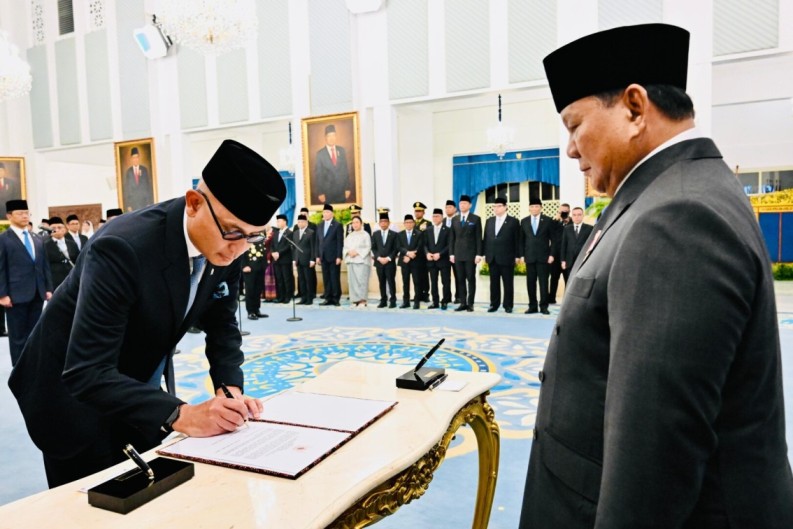
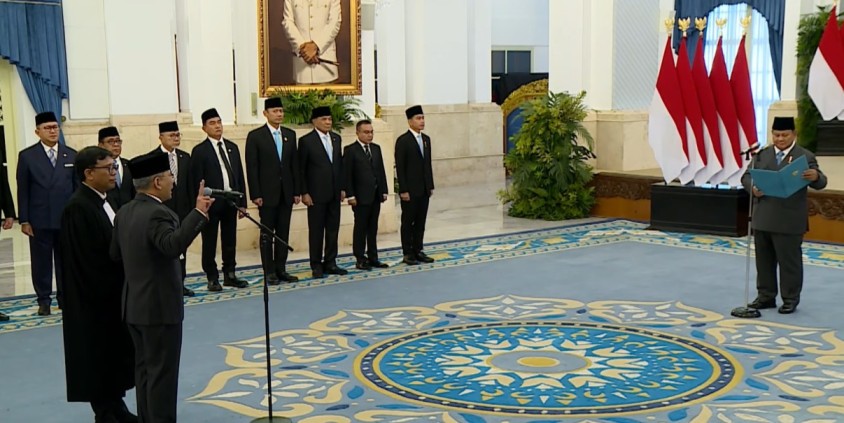
The president of the Republic of Indonesia, Prabowo Subianto, inaugurated Arrmanatha Nasir as the Indonesian Minister of Foreign Affairs at the State Palace in Jakarta on Thursday, October 1, 2026. (The Indonesian Foreign Ministry)
The appointment of Arrmanatha Christiawan Nasir as Indonesia’s Minister for Foreign Affairs on 1 October 2026 is significant not simply because he is a career diplomat. What matters more is the kind of experience that has shaped him.
Over nearly three decades at the Ministry of Foreign Affairs, Arrmanatha—widely known as Tata—has not merely moved from one diplomatic post to another. He has been directly involved in complex multilateral negotiations, bilateral crises, the protection of Indonesian citizens, debates over sovereignty, and efforts to reform international institutions.
That record may offer a clearer indication of the kind of foreign minister he will be than any formal list of positions he has held.
Learning negotiation from inside the UN system
Long before becoming Indonesia’s Permanent Representative to the United Nations, Tata had already worked at the heart of multilateral diplomacy.
During his posting to Indonesia’s Permanent Mission in New York from 2008 to 2012, he handled economic and development issues in the UN General Assembly’s Second Committee and in ECOSOC (United Nations Economic and Social Council). During this period, he also negotiated on behalf of the Group of 77 (G77) and China on a number of resolutions.
That experience matters because multilateral diplomacy rarely produces absolute victories. It requires the ability to understand the interests of dozens of countries, draft language that can attract broad support, and judge when to hold firm and when compromise is necessary.
Those skills were again evident when Tata later served as Indonesia’s Permanent Representative to the UN. In 2023, together with Australia’s Permanent Representative Mitchell Fifield, he was appointed co-facilitator of negotiations on the political declaration for the Midterm Review of the Sendai Framework for Disaster Risk Reduction.
He also served as Vice-President of ECOSOC and chaired its Coordination Segment in 2023.
This is one of the less visible sides of Tata’s diplomacy: not simply delivering statements from a podium, but working inside the difficult process of negotiation and consensus-building.
Ukraine: Upholding principles, while questioning the process
Indonesia’s position on the Russia–Ukraine war provides another example of Tata’s diplomatic approach.
At the UN General Assembly in February 2023, Indonesia supported a resolution reaffirming Ukraine’s sovereignty and territorial integrity and calling for the withdrawal of Russian forces.
But Tata did not stop at expressing support.
He explained that Indonesia’s position was rooted in the UN Charter, international law, the peaceful settlement of disputes, and respect for the rule of law. At the same time, he openly noted that several elements proposed by Indonesia during the drafting process had not been reflected in the final text, particularly proposals intended to help create conditions for dialogue and peace.
His language was notably direct.
He argued that General Assembly resolutions should be factual, accurate, inclusive, and balanced. He even cautioned that UN resolutions should not become ‘social media content’ shaped merely to reinforce one particular narrative.
The episode revealed a consistent pattern: support for international principles, combined with a willingness to question whether diplomatic instruments are actually bringing parties closer to a solution.
Palestine: Diplomatic language without ambiguity
On Palestine, Tata has also used unusually clear language.
At the International Conference on the Implementation of the Two-State Solution in New York in July 2025, he stressed that recognition of Palestine was not an act of generosity or a political gift, but a matter of international law and justice.
Indonesia also led a working group on security issues at the conference, including discussions on international protection mechanisms, Gaza stabilization, and strengthening the capacity of the Palestinian Authority.
For Tata, Palestine has not appeared to be simply a diplomatic position repeated from year to year. His approach has been more substantive: how political support can be translated into international mechanisms that actually function.
When diplomacy requires firmness
Before he became widely known for multilateral diplomacy, the Indonesian public saw another side of Tata during his tenure as Foreign Ministry spokesperson.
One of the most prominent moments came in 2015 during the Bali Nine case.
When Australian Prime Minister Tony Abbott linked Australia’s post-tsunami assistance to Indonesia with an appeal for clemency for Andrew Chan and Myuran Sukumaran, Tata responded publicly.
He stated that “threats are not part of diplomatic language” and reminded Australia that no country responds well to threats.
What was striking, however, was that firmness did not automatically lead to escalation.
Several months later, when Australia reduced its foreign assistance to Indonesia, Tata resisted immediately linking the decision to the Bali Nine executions. Instead, he pointed to Australia’s fiscal considerations and emphasized the continuing importance of bilateral relations.
The two episodes showed an important diplomatic balance: firmness when national dignity and interests are at stake, but restraint when escalation serves no purpose.
People smuggling: Demanding consistency from Australia
Another difficult issue with Australia emerged when allegations surfaced that Australian officials had paid crew members of a people-smuggling vessel to return asylum seekers toward Indonesia.
As Foreign Ministry spokesperson, Tata demanded clarification.
When Australia’s explanation was considered insufficient, he said Indonesia could not be blamed if it then believed that such payments had indeed taken place.
“If a country says that it is committed to combating people smuggling, then show us and prove it to us,” he said at the time.
Yet even in the same controversy, Tata also emphasized the humanitarian dimension.
When an asylum-seeker vessel was pushed back to sea and later ran aground, he stressed that the issue concerned human safety, including women and children.
Again, the same combination appeared: national interest, legal principle, and humanitarian concern.
Abu Sayyaf: Diplomacy in the middle of a crisis
When ten Indonesian crew members from the vessels Brahma 12 and Anand 12 were abducted by the Abu Sayyaf group in the Philippines in 2016, Tata was again at the forefront of the Foreign Ministry’s public communication.
He explained the chronology of the hostage-taking, contacts between the kidnappers and the ship owner, and the ransom demands made by the group. At the same time, the Indonesian government was conducting intensive coordination with the Philippines to secure the hostages’ release.
In another hostage case that same year, Tata also reaffirmed the government’s position that Indonesia would not pay ransom to kidnappers.
This episode showed a very different side of diplomacy from negotiations in New York.
In situations like this, diplomacy is no longer measured by the wording of resolutions or political statements. It is measured by the safety of citizens.
North Korea: Preserving space for dialogue
Tata also articulated Indonesia’s approach to the Korean Peninsula with notable clarity.
When tensions rose in 2016 following North Korea’s nuclear and missile tests, he said Indonesia had repeatedly urged Pyongyang to refrain from provocative actions.
At the same time, Indonesia maintained relations with both North and South Korea.
According to Tata, that position allowed Indonesia to preserve channels of communication and to offer itself as a possible facilitator for reconciliation between the two Koreas.
This approach reflects another characteristic of his diplomacy that remains relevant as foreign minister: maintaining access and dialogue even when relations between states are under severe strain.
Papua and the limits of diplomatic flexibility
On sovereignty, Tata’s language has been considerably firmer.
After several Pacific countries raised the issue of Papua at the UN General Assembly in 2016, Tata explained that Indonesian diplomats are trained to defend the country’s interests and sovereignty.
His words were unequivocal: “For our diplomats, the integrity of the Republic of Indonesia is non-negotiable.”
He added that no part of Indonesia’s territory should be questioned in international forums, except for areas that remain subject to formal border negotiations.
Later, as Indonesia’s Permanent Representative to the UN, the same approach remained visible. In a formal letter to the UN Secretary-General in 2022, Tata rejected the use of human rights concerns as a justification for supporting separatism, while also acknowledging that improving human rights, democracy, governance, and welfare remained an ongoing national responsibility.
Paris: More than a representational posting
Tata’s posting in Paris also demonstrated that he was not content merely to perform a representational role.
As Indonesia’s Ambassador to France and Permanent Delegate to UNESCO, he openly criticized the slow pace of reform within the organization.
In 2020, he argued that if UNESCO wanted to remain relevant, its strategic transformation needed to move faster, noting that a reform process launched several years earlier had progressed too slowly.
That concern with institutional reform later reappeared in several of his statements at the United Nations.
At the end of his posting in Paris, the French government awarded him the rank of Commandeur de la Légion d’Honneur for his contribution to strengthening relations between Indonesia and France.
The award provided a symbolic conclusion to a posting that combined bilateral diplomacy with multilateral engagement.
More than a career diplomat
For that reason, describing Arrmanatha Nasir simply as a ‘career diplomat’ does not fully capture his professional trajectory.
His record reveals several consistent traits.
He is accustomed to multilateral negotiations that require patience and compromise. He can use very firm language when sovereignty or pressure on Indonesia is involved. Yet he is also capable of lowering tensions when preserving a bilateral relationship is more important than prolonging a dispute.
He has dealt with citizen-protection crises, humanitarian issues, international conflict, development diplomacy, and the reform of global institutions.
Perhaps most importantly, he has worked on both sides of diplomacy: as a negotiator behind the table and a communicator in front of the public.
In that sense, Tata’s career recalls the tradition represented by diplomats such as Marty Natalegawa: deeply comfortable with multilateral diplomacy, experienced in complex negotiations, able to articulate Indonesia’s position precisely, and prepared to be firm when national interests require it.
But Tata brings his own generation of experience. His career stretches from the G77 and ECOSOC to Ukraine and Palestine, from people smuggling and hostage crises to debates on sovereignty and the reform of UNESCO.
All of those experiences now converge in a single office.
As Foreign Minister, Arrmanatha Nasir is no longer responsible only for explaining Indonesia’s position or negotiating a particular text. He must now direct the country’s entire diplomatic machinery.
In a world increasingly shaped by conflict, geopolitical pressure, and competing interests, his record offers some clues to the style he may bring to the job: engage when room for compromise remains, stand firm when Indonesia’s interests demand it, and ensure that diplomacy produces something more concrete than statements alone.
Perhaps that is where the real story of Arrmanatha Nasir as Indonesia’s Foreign Minister begins.
End
Author: Dian Priheryanti Havid [Doctoral (PhD) Student of Ubhara Jakarta]
Bagikan

Komentar
Berita Terkait
Indonesian president calls on ASEAN not to become proxy
Indonesia
•
03 Feb 2023
Indonesian Ulemas Council bans Israeli products
Indonesia
•
11 Nov 2023
Indonesian president to lead 7 meetings of 42nd ASEAN Summit
Indonesia
•
29 Apr 2023
Indonesia urges NAM to find permanent solution for Palestine
Indonesia
•
23 Jun 2021


Berita Terbaru
Indonesia to host 50th MABIMS SOM, strengthening regional Islamic cooperation
Indonesia
•
29 Sep 2026
Profile – Indonesian Islamic boarding school student discovers security flaws in systems of NASA, University of Melbourne
Indonesia
•
17 Sep 2026
Suahasil Nazara Indonesia’s new finance minister, replacing Purbaya
Indonesia
•
14 Sep 2026
Indonesia’s professor: ‘Dhikr’ in Islam not merely verbal utterance, but matter of awareness and conduct
Indonesia
•
14 Sep 2026