A journey of faith: Hendra Wijaya cycles 15,234 km from Indonesia’s Bogor to Makkah for Hajj

30 September 2026

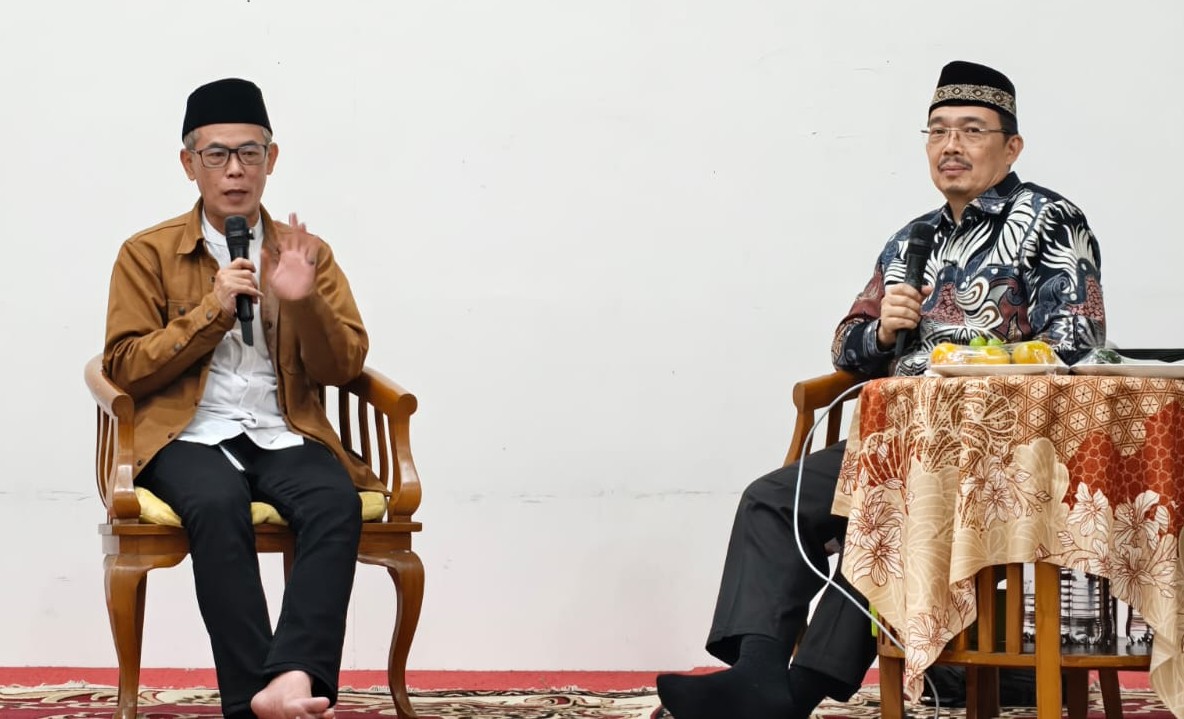
Indonesian ultra-marathon runner Hendra Wijaya (left) during an exclusive interview with Indonesia Window in Bogor district, West Java province, on September 22, 2026. (Indonesia Window/Ronald Rangkayo)
In June 2014, Hendra Wijaya stood atop Mount Kilimanjaro in Tanzania, Africa’s highest peak at 5,895 meters. Two years later, he ran 400 kilometers across the punishing Gobi Desert in Inner Mongolia over nearly a month. In 2017, he crossed Nepal from west to east, running 1,600 kilometers toward the Himalayas.
His life once hung in the balance, too. In March 2015, Hendra tried to reach the North Pole from Canada, running 566 kilometers through temperatures as low as minus 50 degrees Celsius. The experience earned him a place in Indonesia’s sporting history as the first Indonesian to complete the Likeys 6,633 Ultra.
At his home country, mountains over 2,000 meters—from Sumatra to Papua—have become familiar terrain for the seasoned athlete. He has repeatedly taken part in ultramarathons across punishing landscapes and extreme weather, and has organized races of his own.
As an ultra-trail runner, Hendra has explored some of the world’s harshest places on foot, at a run, and by bicycle. Yet by 2025, one destination remained especially meaningful—and untouched: Makkah, the holy city.
“Many of my friends encouraged me to run to Makkah,” he said in a recent interview with Indonesia Window at his office in Sentul City area, Indonesia’s Bogor district in West Java province.
However, the idea did not immediately take hold. What mattered to Hendra was not simply reaching Makkah.
“My goal was to perform Hajj, not merely to get to Makkah. If all I wanted was to reach Makkah, I could do that at any time. I could take it easy, but Hajj takes place at a specific time,” he said.
In 2025, Hendra finally resolved to cycle to the Holy Land to fulfill the fifth pillar of Islam. The plan called for meticulous preparation: Bogor lies 15,234 kilometers from Makkah.
“At first, I planned to set off on February 1. Once I calculated the distance, I realized I would need to cycle 200 kilometers a day. I would also have to cross by ferry from Indonesia’s Merak area in Banten Province to Bakauheni Sub-district, from Indonesia’s Dumai City in Riau Province to Port Dickson in Malaysia, and from Bandar Abbas in Iran to Sharjah in the United Arab Emirates,” he explained.
Then came an unexpected setback. “I spent six days in the ICU and another four in a regular ward—10 days in all. I was discharged on January 28,” he noted.
Still bearing fresh stitches from surgery, Hendra began his long journey. On February 16, 2025, he set off for the Holy Land from MITOSH Sports & Ecotourism in Sentul City, Bogor District, West Java Province.
“I believed every step would help me heal. For the first month, I was very careful, especially when moving around or eating. Thank God, after a month, my condition began to improve,” he said.
Hendra had already paid for a mujamalah (official/non-quota) Hajj visa—one outside the regular Hajj quota—through a travel agency in Bogor. He hoped it would be issued in time for the pilgrimage.
The departure delay of more than two weeks from his original schedule forced him to focus even more closely on his ‘sacred mission’.
“My schedule became extremely tight because I had to arrive in time for Hajj. I had to stay focused and turn down many invitations to meetings and podcasts along the way. My goal was to perform Hajj, not simply to get to Makkah,” he said firmly.
Over roughly four months, Hendra crossed seven countries. He sailed across the Strait of Malacca from Indonesia’s Riau Province to Malaysia, continued through Thailand and China, then crossed the Pakistan–Afghanistan border region, a flashpoint in the military conflict between the two South Asian neighbors.
From there, he cycled on to Iran, crossed the Strait of Hormuz to the United Arab Emirates (UAE), and finally entered Saudi Arabia.
Hendra called the pilgrimage journey ‘Majestic Ice Road’. He made it entirely alone.
“I had no support team. I’m not a content creator or blogger. I had a GoPro on my bicycle, two trackers, one GSM phone and one satellite phone. GSM worked in many countries, but it was blocked in Iran,” he said.
Years of mountain climbing and dozens of ultratrail races across extreme terrain had strengthened his body. The natural conditions, he said, were manageable. The danger came from the routes themselves.
“Nature wasn’t a problem; I was used to it. The hard part was taking dangerous routes, like the one near the Pakistan–Iran border. There had been killings, and people advised me to fly. But I chose the route through Afghanistan so I could keep cycling,” Hendra said.
In Afghanistan, he met several members of the Taliban and was welcomed into one of their bases. He said they treated him with warmth and a sense of kinship.
“They turned out to be friendly. They joked around and helped me. They couldn’t believe a 59-year-old Indonesian could cycle all the way to Makkah. So the biggest challenge wasn’t physical—it was security,” he said.
Upon reaching the UAE, Hendra waited in Ruwais (the UAE) for 10 days for his Hajj visa.
“At the time, I heard that many Hajj visas were being rejected, and many Indonesian pilgrims had to cancel their journeys. So when my visa finally came through, I cried with happiness. It was the first time I’d ever cried from joy”. Hendra recalled softly, wiping away a tear.
For him, the visa was ‘a gift after a long struggle, including being sick and undergoing surgery’.
“Getting to Makkah wasn’t the hardest part. Hajj was. Reaching Makkah without a Hajj visa would not make the pilgrimage valid. The happiest moment was when the visa came through. I saw it as fate and a test from Allah,” he said.
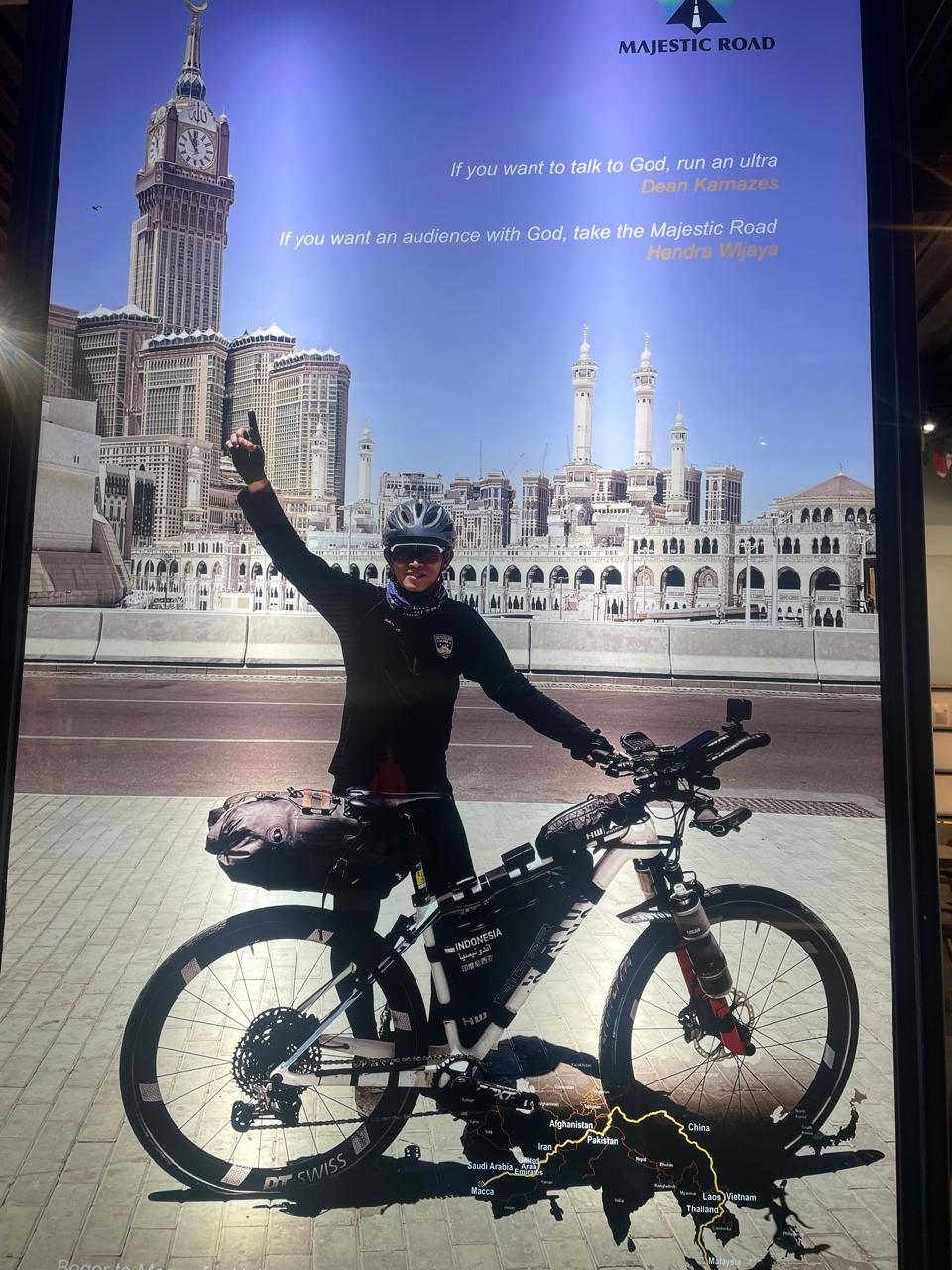
On the 100th day of his ‘Majestic Ice Road’ journey, Hendra entered miqat at dawn—the point at which pilgrims form their intention to perform Hajj and put on the ihram clothings. About two hours before noon, he arrived at the Grand Mosque, where the temperature had climbed to 50 degrees Celsius.
Miqat refers to the time and place boundaries established by Islamic Sharia for declaring the intention of ihram (entering the state of ritual consecration for the Hajj and Umrah pilgrimage). Ihram is a person’s spiritual status marked by the intention to begin in the Hajj or Umrah (minor hajj) pilgrimage, accompanied by wearing special clothing and complying with various sharia prohibitions.
On June 4, 2025—8 Dhu al-Hijjah 1446—Hendra joined more than 1.6 million Muslims from around the world as they began the Hajj pilgrimage, which continued through June 9, or 13 Dhu al-Hijjah.
Reporting by Indonesia Window
Bagikan

Komentar
Berita Terkait
Feature: Sri Mulyani – Retno Marsudi, ‘Heroine Duo’ at G20 Indonesia Summit
Indonesia
•
20 Nov 2022
Prigen Conservation Breeding Ark conserves Indonesia’s endangered endemic songbirds
Indonesia
•
20 Dec 2025
Qatar Charity distributes food packages for Indonesians affected by COVID-19
Indonesia
•
04 May 2020

Eating outside is cause of 50 pct of food allergies: Saudi authority
Indonesia
•
28 May 2022

Berita Terbaru
Indonesian Islam convert introduces ‘Chrislamology’ to strengthen Islamic faith
Indonesia
•
15 Sep 2026

Feature – From barefoot to high-tech: How Chinese doctors shaped a healthier nation
Indonesia
•
23 Aug 2026
Feature – Paddling, camping, birdwatching: How a greener China reshapes urban getaways, lifestyles
Indonesia
•
17 Aug 2026
The rain, the caves and the quest to preserve Mogao Grottoes
Indonesia
•
16 Aug 2026