Feature – Indonesian salt farmers facing climate change and rising costs

14 May 2026
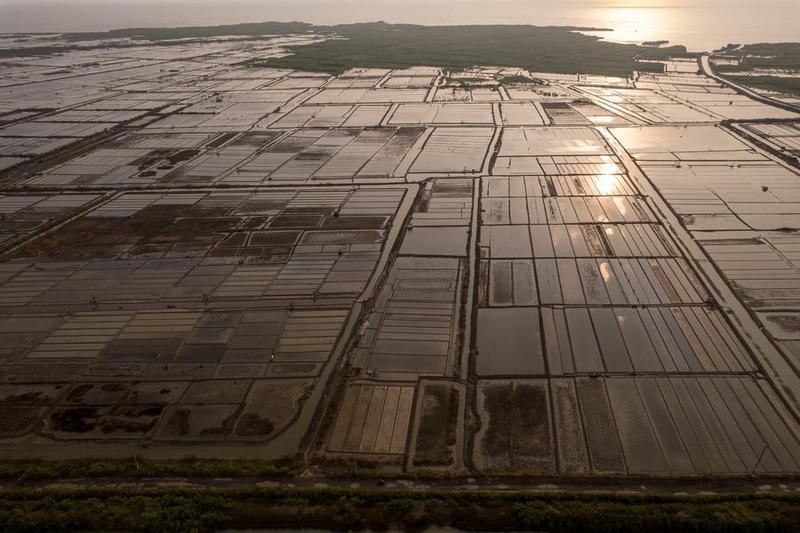
This aerial photo taken by drone on May 12, 2026, shows a salt pond in Rawaurip village, Cirebon district, West Java province. (Xinhua/Veri Sanovri)
Salt production requires long stretches of dry days without interruption. Just one heavy rainfall can wash away weeks of hard work.
Cirebon, W Java (Indonesia Window) – Across the vast, sun-scorched salt fields in Cirebon, Indonesia’s port city in West Java province, life is measured not by the ticking of clocks, but by the rhythm of the sun, wind, and sea.
For generations, families like those of Ipin and Raihan have harvested salt from shallow ponds along the northern coastline. Their livelihood depends on a simple yet exhausting process: using intense sunlight to evaporate seawater until mounds of salt crystals form.
Their schedule is largely dictated by nature, leaving little room for human intervention.
In recent years, however, that once-reliable rhythm has become increasingly unpredictable. Declining harvests have tested the resilience of local farmers whose livelihoods depend on cooperation between the weather and the shifting tides.
“Last year’s harvest was not very good,” Ipin (38), a farmer from Rawaurip village. said, adding, “we experienced a wet dry season, and rain came when we needed sunshine”.
Timing is crucial. Salt production requires long stretches of uninterrupted dry weather. According to local farmers interviewed by Xinhua, a single heavy downpour can wipe out weeks of labor.
Beyond rainfall, rising tidal floods have become an even greater threat to the low-lying salt ponds.
“Tidal flooding is even worse than rain,” said Raihan (39), who returned from Jakarta in 2015 to become a full-time farmer. “When tidal floods come, we have to start everything all over again,” he said.
As a result, local farmers have been forced to diversify their work. During the rainy season, when salt production becomes impossible, Raihan grows vegetables, chili peppers, and corn to supplement his income.
“We have to be versatile,” he said, noting that “nature determines our schedule, so we must adapt”.
Climate pressures are also compounded by soaring operational costs.
The price of essential plastic sheets — disposable materials used during the final evaporation stage — has jumped from 2.2 million rupiahs to 3 million rupiahs per batch.
*1 U.S. dollars = 17,504 rupiahs
With profit margins becoming increasingly thin, even the slightest fluctuations in weather or market prices can push these family businesses to the brink of collapse.
Although the 2026 dry season is forecast by the government to last longer than usual, local salt farmers are facing the changes with unwavering determination.
“Every year brings its own challenges,” Ipin said while gazing at his evaporation ponds shimmering in the dawn light. “But salt is our life, and we will keep harvesting it no matter what happens, whether the rain falls or the tides rise,” remarked.
Reporting by Indonesia Window
Bagikan

Komentar
Berita Terkait

Press, social media serve as alternative force to put pressure on Israel
Indonesia
•
25 Jun 2020

Short book review: PRITA KEMAL GANI, 30 years serving as an educator, playing multi roles being a leader, public relations figure, wife and mother
Indonesia
•
30 Nov 2022

COVID-19 – Herd immunity approach to pandemic unethical: WHO
Indonesia
•
14 Oct 2020

Xinhua, Reuters presidents hold talks on cooperation
Indonesia
•
15 Jun 2024


Berita Terbaru

Feature – From barefoot to high-tech: How Chinese doctors shaped a healthier nation
Indonesia
•
23 Aug 2026

Feature – Paddling, camping, birdwatching: How a greener China reshapes urban getaways, lifestyles
Indonesia
•
17 Aug 2026

The rain, the caves and the quest to preserve Mogao Grottoes
Indonesia
•
16 Aug 2026

China aims to elevate basic education with focus on virtue, health and equity
Indonesia
•
29 Jul 2026