News Focus – Microplastics found at depth of 2,450 meters in Indonesia’s throughflow, threatens human food chain

08 March 2026
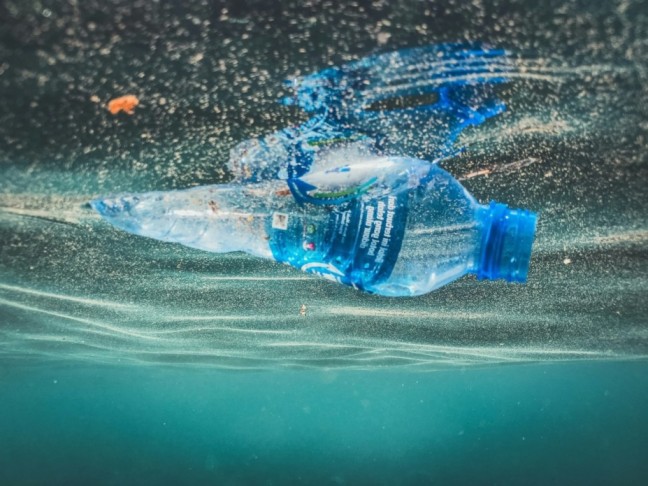
Illustration. Plastic bottle and single use plastic in the ocean. Captured in Indonesia. (Naja Bertolt Jensen on Unsplash)
Microplastics have reached the depths of around 2,450 meters along the main pathway of the Indonesian Throughflow (ITF), a major ocean current system connecting the Pacific Ocean and the Indian Ocean.
Jakarta (Indonesia Window) – The threat of microplastics is not limited to the ocean surface. A recent study has found that these tiny plastic particles have reached the depths of approximately 2,450 meters along the main pathway of the Indonesian Throughflow (ITF), a major ocean current system connecting the Pacific and Indian Oceans.
The findings were published in the international scientific journal Marine Pollution Bulletin in a 2024 article titled ‘Vertical Distribution of Microplastic Along the Main Gate of Indonesian Throughflow Pathways.’
The study was led by Corry Yanti Manullang, a researcher from the Deep Sea Research Center of Indonesia’s National Research and Innovation Agency (known as its abbreviation BRIN), in collaboration with international researchers from Malaysia, the United States, and China, according to article quoted from BRIN's website, on Sunday.
The Indonesian Throughflow is a strategic ocean current that flows through several important straits in Indonesia, including the Makassar Strait, Alas Strait, and Lombok Strait. The current transports not only water masses, salt, and nutrients, but also has the potential to carry microplastic particles across different ocean layers.
“The Indonesian Throughflow connects two major oceans, the Pacific and the Indian. In addition to transporting water masses and nutrients, this current can also carry small particles such as microplastics,” Corry said.
Until now, most studies on the Indonesian Throughflow have focused on physical oceanographic aspects such as temperature, salinity, and current dynamics. Meanwhile, the distribution of microplastics within the water column, especially at deep-sea levels, has rarely been studied.
According to Corry, this research represents one of the early studies examining the vertical distribution of microplastics into the deep sea along the Indonesian Throughflow pathways.
“Most microplastic research in Indonesia still focuses on surface waters or coastal areas. Studies reaching deep-sea environments remain very limited,” she said.
Samples from thousands of meter deep
The study was conducted during an oceanographic expedition from January to April 2021 as part of the international collaborative program TRIUMPH.
Sampling was carried out at 11 research stations stretching from the Makassar Strait to the Lombok Strait.
Researchers collected 92 seawater samples from various depths, ranging from five meters to approximately 2,450 meters below the ocean surface.
Samples were collected using a rosette sampler connected to a CTD (Conductivity, Temperature, Depth) system, enabling researchers to take water samples at precisely predetermined depths.
“Sample bottles are lowered into the sea and closed at specific depths, for example at 50 meters, 200 meters, or even thousands of meters,” Corry explained.
From a total of 872 liters of seawater analyzed, researchers identified 924 microplastic particles, with an average concentration of about 1.062 particles per liter. Microplastics were found at all research locations, including depths exceeding two kilometers.
Analysis also showed that more than 90 percent of the microplastics detected were in the form of fibers, which generally originate from synthetic textiles.
“The clothes we wear can also generate microplastics. When they are washed, tiny fibers from synthetic fabrics can be released and eventually enter aquatic systems,” she said.
Through Raman spectroscopy analysis, researchers identified several types of plastic polymers, including polyester, polypropylene, and polyurethane, which are widely used in textile products, packaging materials, and industrial applications.
The findings suggest that the deep sea may serve as an accumulation zone for microplastics.
“At certain depths, the Indonesian Throughflow is strong enough to transport and distribute plastic particles across different water layers,” Corry said.
Microplastics in the food chain
In addition to studying the distribution of microplastics in the ocean, the research team also examined the possibility that these particles have already entered the marine food chain.
In another study published in the journal Sains Malaysiana in 2024, titled ‘Ingestion of Microplastics in the Planktonic Copepod from the Indonesian Throughflow Pathways’, the team discovered microplastics in the bodies of small zooplankton organisms known as copepods within the Indonesian Throughflow pathways.
Copepods are among the most abundant types of zooplankton in the ocean and serve as a crucial food source for many fish species.
In the study, around 6,000 copepod individuals from several locations along the Indonesian Throughflow pathways were analyzed. The results showed that 133 microplastic particles were found inside their bodies.
The average ingestion rate was about 0.022 particles per individual, equivalent to roughly one plastic particle for every 45 copepods.
“Copepods cannot distinguish between natural food and plastic particles. Anything that passes in front of them is captured and eaten,” Corry explained.
The research also showed that larger copepods tended to contain more microplastics than smaller ones.
The presence of microplastics in copepods raises serious concerns because these organisms are a primary food source for many fish species.
“Copepods are eaten by small fish, which are then eaten by larger fish, and eventually those fish are consumed by humans. This means microplastics can potentially move through the food chain all the way to humans,” she said.
Challenges in deep-sea research
Corry added that research on microplastics in Indonesian waters still needs to be further expanded, particularly in deep-sea areas.
Around 70 percent of Indonesia’s marine territory has depths exceeding 200 meters, meaning deep-sea ecosystems remain relatively understudied.
“The finding that microplastics have reached depths of more than two kilometers shows that plastic waste is not only a coastal issue. It has become a problem for the entire marine ecosystem,” she said.
Corry expected the findings could serve as a foundation for further studies on the movement of microplastics in deep waters and their impacts on marine organisms and food chains.
A better understanding of microplastic distribution in the ocean is also considered important for supporting policies on plastic waste management and efforts to protect Indonesia’s marine ecosystems.
Reporting by Indonesia Window
Bagikan

Komentar
Berita Terkait

Bacteria have mechanism to overcome plant cells’ immune response: Research
Indonesia
•
03 Jun 2022

Saudi’s Mount Shada has 3,000-years old caves
Indonesia
•
15 Aug 2020

Styrofoam waste dominates mouths of Jakarta rivers
Indonesia
•
13 Dec 2019
China's new materials forge ahead with innovation, application
Indonesia
•
01 Aug 2024


Berita Terbaru

Feature – China pioneers AI-driven education as world seeks new schooling models
Indonesia
•
23 Aug 2026

China marks National Ecology Day with solid gains in green push
Indonesia
•
17 Aug 2026

Beijing ranks among global megacities with high biodiversity levels
Indonesia
•
25 May 2026
China increasingly significant in global biodiversity conservation, says British plant charity
Indonesia
•
25 May 2026