Indonesia’s B50 test in mining sector shows positive results

07 April 2026
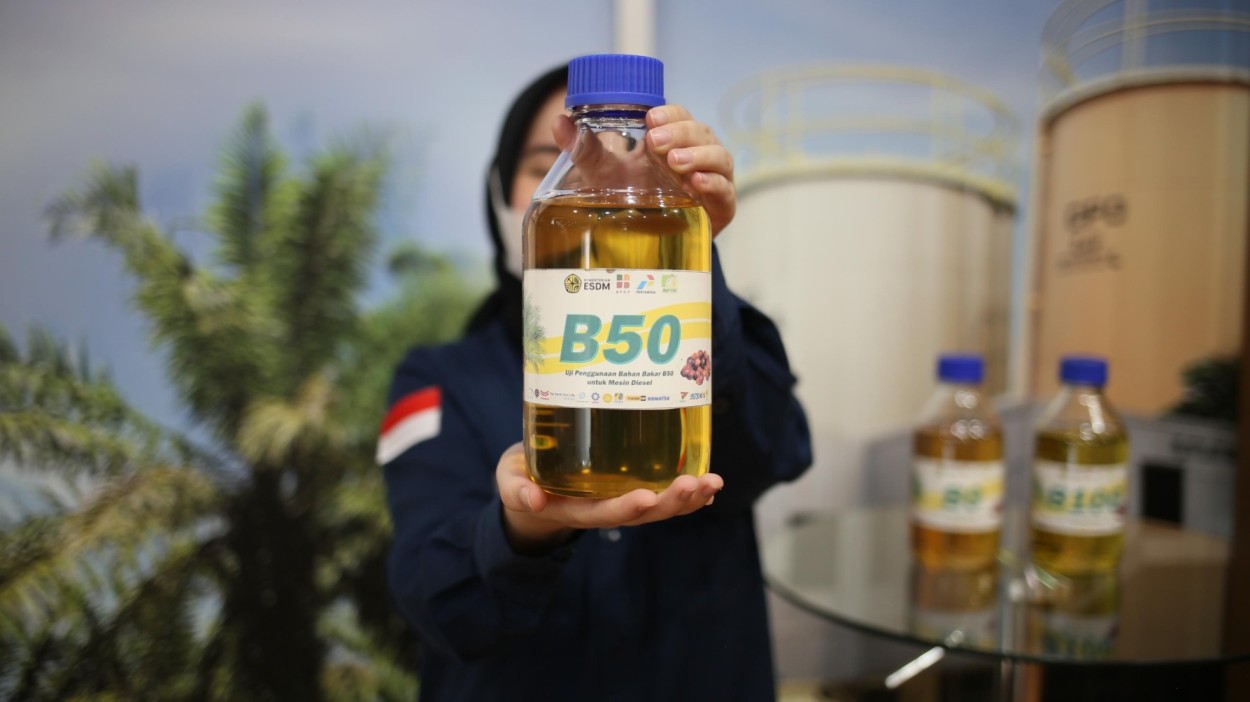
This undated photo shows a worker displaying a bottle of B50 biodiesel fuel. (The Indonesian Ministry of Energy and Mineral Resources)
B50 in diesel engines in the mining sector has demonstrated strong performance, both operationally and technically.
Jakarta (Indonesia Window) – A recent trial of 50 percent biodiesel (B50) in heavy equipment in the mining sector yielded encouraging results.
The government views this achievement as a strong signal that renewable energy is increasingly ready to become the backbone of Indonesia’s national energy security amidst global uncertainty.
The Director General of New, Renewable Energy and Energy Conservation at the Indonesian Ministry of Energy and Mineral Resources, Eniya Listiani Dewi, stated that the preliminary results of the B50 testing show stable engine performance without significant disruptions.
"In general, the use of B50 in diesel engines in the mining sector demonstrates strong performance, both operationally and technically. This is a strong indication that biodiesel can be relied upon to support the industry," she said here on Friday (April 3), quoted from the ministry’s website.
The testing was comprehensive, examining fuel quality, engine performance, operational durability, and storage stability. By the end of March 2026, dynamic durability testing of B50 had exceeded 900 operational hours without any indication of fuel-related problems.
Meanwhile, the general manager of the PT Harmoni Panca Utama plant, Rochman Alamsjah, stated that his company had directly compared the use of B40 and B50 in heavy equipment.
"Up to nearly 1,000 operational hours, engine performance remained stable. There was only a small note: B50 fuel consumption was slightly higher, around 1-3 percent," he explained.
Although there was an increase in fuel consumption of around 3.12 percent compared to B40, this figure was considered within reasonable limits and did not significantly impact heavy equipment productivity.
Technically, B50 also met various important parameters, such as water content, oxidation stability, and FAME (Fatty Acid Methyl Ester) levels. This strengthens B50's readiness for use in high-workload sectors such as mining.
As part of the national biodiesel mandate program, B50 is a blend of 50 percent biodiesel based on vegetable oil—primarily palm oil—and 50 percent diesel. This policy aims to reduce dependence on fuel imports while encouraging the use of domestic energy.
The success of this trial builds on Indonesia's earlier achievement of implementing B40 nationally in 2025. This move positions Indonesia as a global pioneer in the large-scale use of biofuels.
"The development of B50 is a strategic step toward energy independence. In addition to strengthening energy security, it also adds value to the national economy," Eniya said.
In the future, the government will expand B50 trials to various other sectors, such as transportation, power generation, railways, and agricultural machinery. The results of this testing will form the basis for developing national policies and implementation standards.
This step also emphasizes the government's commitment to encouraging the transition to a cleaner, more sustainable, and more sovereign energy system.
Reporting by Indonesia Window
Bagikan

Komentar
Berita Terkait

Indonesia has 33 thousand species of herbs
Indonesia
•
20 Feb 2020

WWF reports dramatic decline in vertebrate species since 1970
Indonesia
•
11 Sep 2020

China Mobile and Global Mobile Operators explore pathways to a more intelligent future at global partnership executive conference
Indonesia
•
04 Jul 2024

Two-thirds of world's wildlife population decline since 1970: WWF
Indonesia
•
11 Sep 2020


Berita Terbaru

Feature – China pioneers AI-driven education as world seeks new schooling models
Indonesia
•
23 Aug 2026

China marks National Ecology Day with solid gains in green push
Indonesia
•
17 Aug 2026

Beijing ranks among global megacities with high biodiversity levels
Indonesia
•
25 May 2026

China increasingly significant in global biodiversity conservation, says British plant charity
Indonesia
•
25 May 2026