Indonesian Islamic boarding schools encouraged to open ‘Ma'had Aly’

24 May 2026
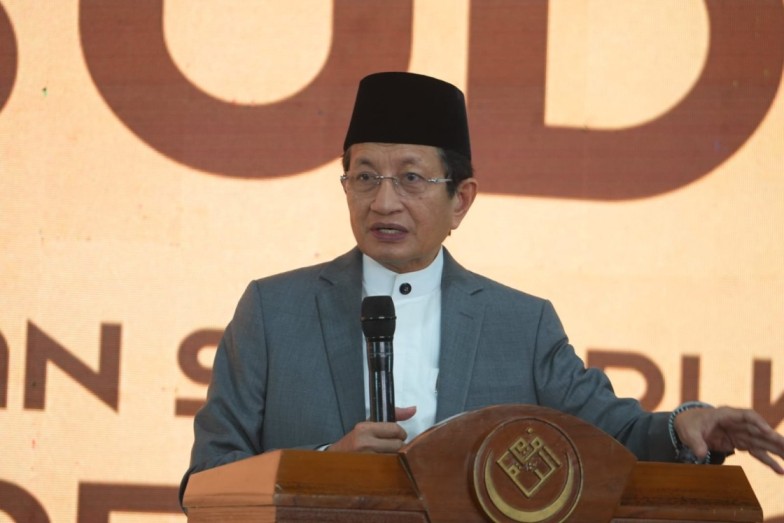
Indonesia’s Minister of Religious Affairs Nasaruddin Umar. (The Indonesian Ministry of Religious Affairs)
Islamic boarding schools can develop ‘Ma'had Aly’ (Islamic higher education institutions) with specific characteristics, including areas of study related to science.
Jakarta (Indonesia Window) – Islamic boarding schools are expected to open Ma'had Aly (Islamic higher education institutions), Indonesia’s Minister of Religious Affairs Nasaruddin Umar said during a briefing at the Luhur Al-Tsaqafah Islamic Boarding School in South Jakarta, on Saturday (May 23).
According to Minister Nasaruddin Umar, Islamic boarding schools with a strong scholarly tradition need to be upgraded so that they do not stop at secondary education but can also become centers for the birth of ulama, scientists, and a generation of moral leaders.
"It would be great if Islamic boarding schools like ours here opened Ma'had Aly (Islamic higher education institutions within Islamic boarding schools) as soon as possible," said the Minister of Religious Affairs, who believes that opening Ma'had Aly is crucial to ensure that students' potential is not cut off after completing aliyah (high school).
Pesantren need to provide further space for students who wish to deepen their knowledge within an educational ecosystem that remains rooted in Islamic boarding school values, said the Minister, as quoted from the Indonesian Ministry of Religious Affairs’ website on Sunday.
However, Ma'had Aly should not be understood narrowly as a place to deepen classical Islamic knowledge, Nasaruddin said, adding that Islamic boarding schools can also develop Ma'had Aly with specific characteristics, including fields related to science.
"Ma'had Aly is also not prohibited from opening anything scientific," said the Minister, who wants Islamic boarding schools to move beyond the perspective that rigidly separates religious knowledge from general knowledge.
In his view, Islamic boarding schools offer a significant opportunity to unite spiritual depth, moral strength, and research traditions within a single educational ecosystem.
The Minister of Religious Affairs stated that the history of the glory of Islamic education demonstrates that knowledge develops when religion, morality, and research work together.
Therefore, today's Islamic boarding schools should not only be spaces for the transmission of tradition, but also be birthplaces of innovation, he added.
"I want to remind my students, that the achievements of the Islamic world in the past were no small feat. In the Middle Ages, when parts of Europe were still in very simple conditions, the Islamic world had made great progress in science, technology, medicine, mathematics, optics, and various other fields," he explained.
"Nevertheless, history also teaches that Muslims later experienced decline. What caused this? From various historical records, we can see that this decline was related to two things: the decline of scientific
When scientific research, discovery, and creativity weaken, the Minister of Religious Affairs stated, civilization also weakens. When morals decline, internal conflicts increase, even among Muslims, leading to disagreements, mutual insults, and power struggles.
"If we want to progress again, there are two things we must do. First, increase research and scientific development. Second, strengthen noble morals," he remarked.
According to him, these two things are essential foundations for the revival of Islamic education. Research and scientific development will make Islamic boarding schools competitive, while morals ensure that progress remains within the framework of public welfare.
Addressing the students, the minister commended the achievements of the Luhur Al-Tsaqafah Islamic Boarding School, which has demonstrated great potential.
He noted that the boarding school's students are not only strong in religious studies but also possess skills in Arabic, English, interpretation, and science.
Those potentials, he argued, have to be nurtured through stronger institutions. The opening of Ma'had Aly can be a strategic step to ensure that Islamic boarding schools maintain continuity of education from elementary, secondary, and tertiary levels.
On that occasion, the minister also touched on the increasingly important role of madrasas and Islamic boarding schools in national education.
He mentioned that many madrasas have proven themselves through academic achievements, character development, and the success of their alumni in entering prestigious universities.
For the minister, one of the strengths of Islamic boarding schools lies in their boarding school education systems.
Through the boarding system, students not only receive lessons in the classroom but are also nurtured in their daily lives. The values of discipline, responsibility, independence, and togetherness develop in a more holistic environment.
He believes that such an educational model is especially important for young students. At this stage, they need an environment that maintains the continuity of values among learning, habits, and social interactions.
Therefore, the minister hopes that the Luhur Al-Tsaqafah Islamic Boarding School can play a greater role in the development of Islamic education in Indonesia.
By opening Ma'had Aly, the Islamic boarding schools are expected to not only produce pious graduates but also a generation capable of meeting the challenges of science and changing times.
"We need to develop schools like this for the future. It's time for religious schools to rise," said the Minister of Religious Affairs.
He expressed his appreciation for the Luhur Al-Tsaqafah Islamic Boarding School and hoped that it would continue to achieve sustainable achievements and become part of the generation of students who are intelligent, moral, and ready to contribute to the nation.
Reporting by Indonesia Window
Bagikan

Komentar
Berita Terkait
Indonesia, Sri Lanka reestablish Parliamentary Friendship Association
Indonesia
•
30 Mar 2021
IMT-GT summit strengthens connectivity, tourism in three countries
Indonesia
•
12 May 2023
News Focus – Students enthusiastic about joining Ramadan short course in Indonesia’s Bogor city
Indonesia
•
24 Mar 2024

Indonesia's ratio of net liability for international investment falls in Q3
Indonesia
•
26 Dec 2022

Berita Terbaru

Minister: Airports affected by Mount Anak Krakatau volcanic ash reopen
Indonesia
•
08 Sep 2026

TETO: Sudut Pandang is one of important mass media in Indonesia
Indonesia
•
06 Sep 2026
Feature – Preserving 180-year-old legacy: UIN Ar-Raniry digitizes Quranic manuscript of Acehnese scholar
Indonesia
•
29 Aug 2026
Opinion – Prophet Muhammad ﷺ and journey toward literacy, ecological awareness
Indonesia
•
27 Aug 2026