Study on Chang'e-5 lunar sample unveils early moon crust building process

01 August 2024
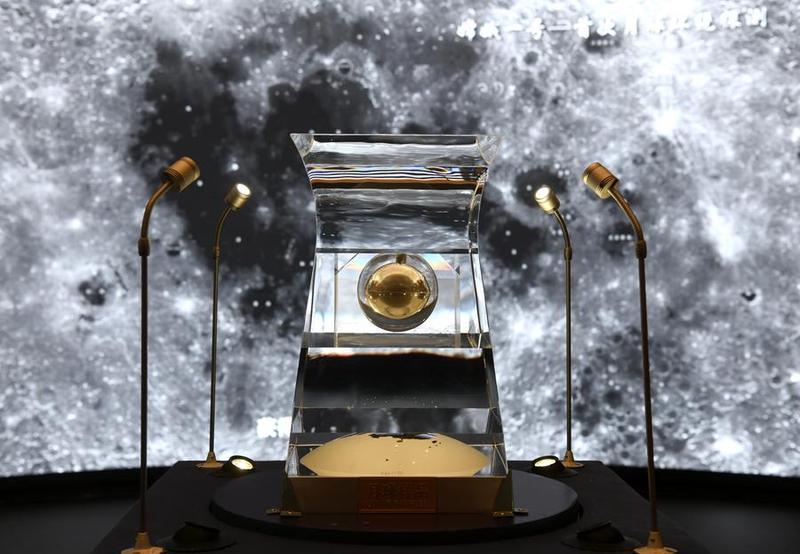
The lunar samples No. 001 brought back by China's Chang'e-5 probe is displayed at the National Museum of China in Beijing, capital of China, Feb. 27, 2021. An exhibition displaying the lunar samples No. 001 brought back by China's Chang'e-5 probe is held here on Saturday. (Xinhua/Jin Liangkuai)
The lunar upper mantle melting induced by in-situ overturn played an important role in linking the lunar primitive crust building and secondary crust reformation.
Beijing, China (Xinhua/Indonesia Window) – After studying a lunar sample brought back by the Chang'e-5 mission, a group of Chinese scientists proposed a continuous early crust development process on the moon, as opposed to the classical two-stage moon crust development model.The classical magma ocean model suggests that the first stage involves the flotation and aggregation of plagioclase during the cooling of the magma ocean, forming the primitive lunar crust, while the second stage includes the overturn and melting of the mantle, the formation of magnesian-suite rocks and the reformation of the lunar crust.Previous studies on the lunar anorthosite, a type of rock mainly composed of plagioclase, and magnesian-suite rocks indicated that they were formed almost simultaneously, indicating that the two stages -- the formation and reformation of the lunar crust -- may be a continuous process. But the specific mechanism remains enigmatic.A group of scientists, led by Wang Shuijiong from the China University of Geosciences (Beijing), have conducted a joint study and discovered a melt body that resembles magnesian-suite rocks in an anorthosite fragment from the Chang'e-5 lunar regolith.The study, which was recently published in the journal Communications Earth & Environment, provides direct evidence that lunar anorthosite and the parent magma of the magnesian-suite rocks formed simultaneously.The geochemical and thermodynamic simulation calculations for this melt body reveal that its parent magma was sourced from the lunar upper mantle, indicating that the formation of the lunar crust is a continuous process, according to the study.The researchers proposed that during the cooling process of the lunar magma ocean, its gravitational instabilities triggered a small-scale, in-situ overturn in the upper mantle, followed by a large-scale mantle overturn and decompression melting of the lower mantle.According to the study, the lunar upper mantle melting induced by in-situ overturn played an important role in linking the lunar primitive crust building and secondary crust reformation.The Chang'e-5 probe, which returned to Earth on Dec. 17, 2020, retrieved 1,731 grams of lunar samples, consisting primarily of rocks and soil from the lunar surface.Reporting by Indonesia WindowBagikan

Komentar
Berita Terkait
China labels farm produce with carbon footprints for greener cultivation
Indonesia
•
01 Aug 2024
Indonesia has more than 1,500 lakes
Indonesia
•
08 Dec 2020
China unleashes new quality productive forces in push for reform, innovation
Indonesia
•
25 Jun 2024

COVID-19 – Indonesia targets mastery of new technology for vaccine production
Indonesia
•
24 Sep 2021


Berita Terbaru

Feature – Humanoid robots shatter human record, showcase autonomy at Beijing half marathon
Indonesia
•
24 Apr 2026

Indonesian researchers develop LFP batteries from iron, steel industrial waste
Indonesia
•
20 Apr 2026
Waste-processing vessel offers solution for coastal, small island areas
Indonesia
•
20 Apr 2026
Indonesia’s B50 test in mining sector shows positive results
Indonesia
•
07 Apr 2026