Study reveals human impact on increased rainfall variability over past century

27 July 2024
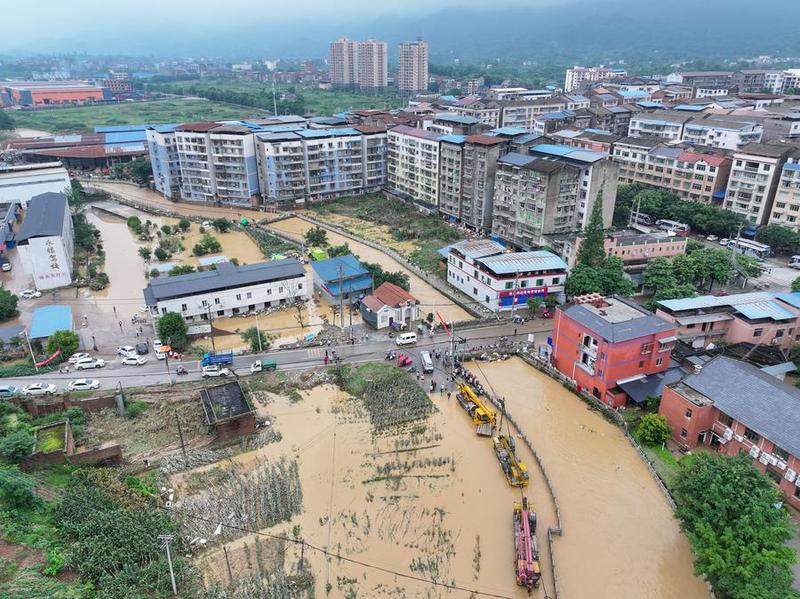
An aerial drone photo taken on July 11, 2024 shows a river after heavy rain in Chengxi Town, Dianjiang County, southwest China's Chongqing Municipality. (Xinhua/Tang Yi)
Rainfall variability has since the 1900s increased in about 75 percent of the land areas studied, particularly in Europe, Australia, and eastern North America.
Beijing, China (Xinhua/Indonesia Window) – A new study has provided evidence showing that human activities have made global rainfall more volatile over the past century.Published on Friday (July 26) in the journal Science, the study was conducted by researchers from the Institute of Atmospheric Physics (IAP) of the Chinese Academy of Sciences, the University of Chinese Academy of Sciences, and the UK Met Office.The study reveals a systematic increase in rainfall variability since the 1900s, ranging from global to regional scales and from daily to intraseasonal timescales.Rainfall variability refers to unevenness in the timing and amount of rainfall. Higher variability means that precipitation is more unevenly distributed over time, resulting in wetter wet periods and drier dry periods. For example, some places may receive a year's worth of rain in just a few days, have long dry spells followed by heavy downpours, or alternate rapidly between drought and flooding.By analyzing a wide range of observational data, the researchers found that rainfall variability has since the 1900s increased in about 75 percent of the land areas studied, particularly in Europe, Australia, and eastern North America. The researchers also discovered that daily global rainfall variability has increased by 1.2 percent per decade.In the process of seeking to understand the causes of increased rainfall variability, the research team identified the dominant role of anthropogenic greenhouse gas emissions, based on an optimal fingerprinting detection and attribution method."The increase in rainfall variability is mainly due to anthropogenic greenhouse gas emissions, which have led to a warmer and more humid atmosphere," said Zhang Wenxia, lead author of the study and an associate professor at the IAP.This means that even if atmospheric circulation remains the same, the additional moisture in the air leads to more intense rain events and more drastic fluctuations between them, Zhang added.Wide and rapid swings between climate extremes not only challenge existing capabilities of modern-day weather and climate prediction systems, but also have cascading impacts on human society, posing threats to the climate resilience of infrastructure, economic development, ecosystem functioning, and terrestrial carbon sinks, said Wu Peili, a scientist at the UK Met Office and co-author of the study."Immediate adaptation measures are essential to address these challenges," Wu added.Reporting by Indonesia WindowBagikan

Komentar
Berita Terkait
Saudi researchers discover 120,000-year-old human footprints
Indonesia
•
17 Sep 2020

Saudi Arabia inaugurates world's largest solar-powered desalination plant
Indonesia
•
01 Jun 2021

Researchers develop novel deep learning model to predict battery lifetime
Indonesia
•
25 Aug 2024

Feature – Humanoid robots shatter human record, showcase autonomy at Beijing half marathon
Indonesia
•
24 Apr 2026


Berita Terbaru

Feature – China pioneers AI-driven education as world seeks new schooling models
Indonesia
•
23 Aug 2026

China marks National Ecology Day with solid gains in green push
Indonesia
•
17 Aug 2026

Beijing ranks among global megacities with high biodiversity levels
Indonesia
•
25 May 2026
China increasingly significant in global biodiversity conservation, says British plant charity
Indonesia
•
25 May 2026