Indonesia's research agency finds highest carbon emissions from seagrass in Java and Sumatra

17 January 2026
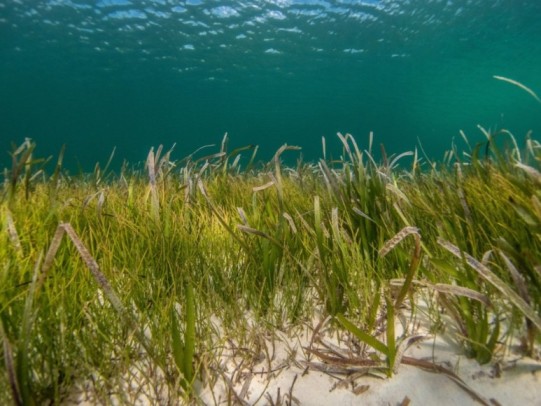
Illustration of seagrass meadows. (Benjamin L. Jones on Unsplash)
Ecosystems of seagrass have long been known as natural carbon sinks in coastal areas, however, recent research by Indonesia’s National Research and Innovation Agency (known as BRIN) has found another equally important aspect: seagrass can also be a source of carbon emissions when damaged.
Jakarta (Indonesia Window) — Seagrass ecosystems have long been known as natural carbon sinks in coastal areas, however, recent research by Indonesia’s National Research and Innovation Agency (known as BRIN) has found another equally important aspect: seagrass can also be a source of carbon emissions when damaged.
Interestingly, the magnitude of these emissions varies across Indonesia. Recent research shows that Java and parts of Sumatra have the highest carbon emission factor from seagrass compared to other coastal areas in the country
This means that the damage to seagrass meadows in western Indonesia has the potential to release carbon into the atmosphere in greater quantities than in the eastern region.
This research was conducted by a researcher at the BRIN Oceanology Research Center, A'an Johan Wahyudi, through a scientific study that specifically calculated carbon emissions due to seagrass ecosystem degradation.
Seagrass absorbs and releases carbon
So far, discussions about blue carbon have focused more on the ability of coastal ecosystems—including seagrass—to absorb and store carbon.
However, according to A'an, the aspect of emissions due to ecosystem damage is often overlooked.
"When we talk about blue carbon, the focus is always on absorption. However, in carbon accounting, what is calculated is not only what is absorbed, but also what is released into the atmosphere," A'an said in a special interview, Wednesday (14/1).
He explained that healthy seagrass is able to absorb and store carbon in biomass and sediment. However, this condition changes when seagrass is disturbed by human activities in coastal areas.
Reclamation to sedimentation triggers emissions
Activities such as coastal reclamation, dredging, and increased sedimentation due to land erosion can inhibit seagrass growth and trigger ecosystem degradation.
However, this condition changes when seagrass is disturbed by human activities in coastal areas. Reclamation to sedimentation triggers emissions Activities such as coastal reclamation, dredging, and increased sedimentation due to land erosion can inhibit seagrass growth and trigger ecosystem degradation.
"Simply put, when seagrass is healthy, carbon is absorbed and stored, but when damaged—for example due to reclamation—the leaves and roots of the seagrass will rot. This decay process releases carbon dioxide into the atmosphere," he explained.
Seagrass does have the ability to filter sediment, but this ability is not unlimited.
If too much sediment enters, the balance of the ecosystem will still be disturbed. In this research, A'an introduced the concept of the seagrass carbon emission factor, which is a number that shows how much carbon is released into the atmosphere per hectare of seagrass ecosystem per year due to degradation.
So far, Indonesia has still used the global emission factor (IPCC Tier-1) to calculate seagrass carbon emissions.
According to A'an, this approach does not reflect the very diverse conditions in Indonesia.
The condition of Indonesian seagrass varies, both in terms of human activity pressure, coastal dynamics, and carbon stocks. Global average figures cannot represent everything," he noted.
The areas in Java and parts of Sumatra, for example, have much higher anthropogenic pressure than the relatively pristine eastern region of Indonesia.
To overcome the limitations of long-term data, A'an uses the chronosequence modeling method, namely comparing the condition of seagrass meadows that are still good with those that have been degraded.
“There is almost no data on seagrass conditions 10-20 years ago. Therefore, areas with seagrass that are still good, such as East Nusa Tenggara, are used as a reference for past conditions," he explained.
The analysis results show that the carbon emission factor for seagrass in Indonesia is in the range of 0.53 to 3.25 tons of carbon per hectare per year.
The highest values were found in Java and parts of Sumatra, while areas such as Nusa Tenggara, parts of Sulawesi, and Maluku showed lower values.
"Densely populated areas with high coastal pressure have greater emission potential," A'an pointed out.
This finding confirms that the location of seagrass damage greatly determines the amount of carbon emissions, even though the area damaged is the same.
Through this research, Indonesia is encouraged to start shifting from the global Tier-1 approach to Tier-2, namely using emission factors that are more specific and tailored to national conditions.
However, A'an emphasized that the emission factor figures produced currently are still preliminary because they only calculate carbon from seagrass biomass.
“In fact, the largest carbon reserves are stored in the sediment," he said.
In the future, combining biomass and sediment data is considered important so that the calculation of seagrass carbon emissions is more accurate and can support national emission reduction reporting, including within the Nationally Determined Contribution (NDC) framework.
To maintain the sustainability of seagrass ecosystems, A'an underscored the importance of strong regulations, consistent enforcement of rules, and the involvement of coastal communities—from waste management to more environmentally friendly development.
He also highlighted the urgency of strengthening the long-term ocean monitoring system through the Indonesia Ocean Observing System (IOOS), which not only monitors the physical conditions of the ocean, but also biogeochemical and ecosystem aspects.
Reporting by Indonesia Window
Bagikan

Komentar
Berita Terkait
First evidence of microplastics found in Antarctic snow
Indonesia
•
09 Jun 2022

Saudi King Abdulaziz public library finds oldest Islamic medical manuscripts
Indonesia
•
15 Sep 2021

Indonesian researchers develop magnesium-based bone implants without removal surgery
Indonesia
•
19 Nov 2025

Chinese scientists discover new tyrannosaur species
Indonesia
•
27 Jul 2024


Berita Terbaru

Feature – China pioneers AI-driven education as world seeks new schooling models
Indonesia
•
23 Aug 2026

China marks National Ecology Day with solid gains in green push
Indonesia
•
17 Aug 2026

Beijing ranks among global megacities with high biodiversity levels
Indonesia
•
25 May 2026
China increasingly significant in global biodiversity conservation, says British plant charity
Indonesia
•
25 May 2026