Feature – Agarwood, enduring fragrance with staggering business value

26 April 2026

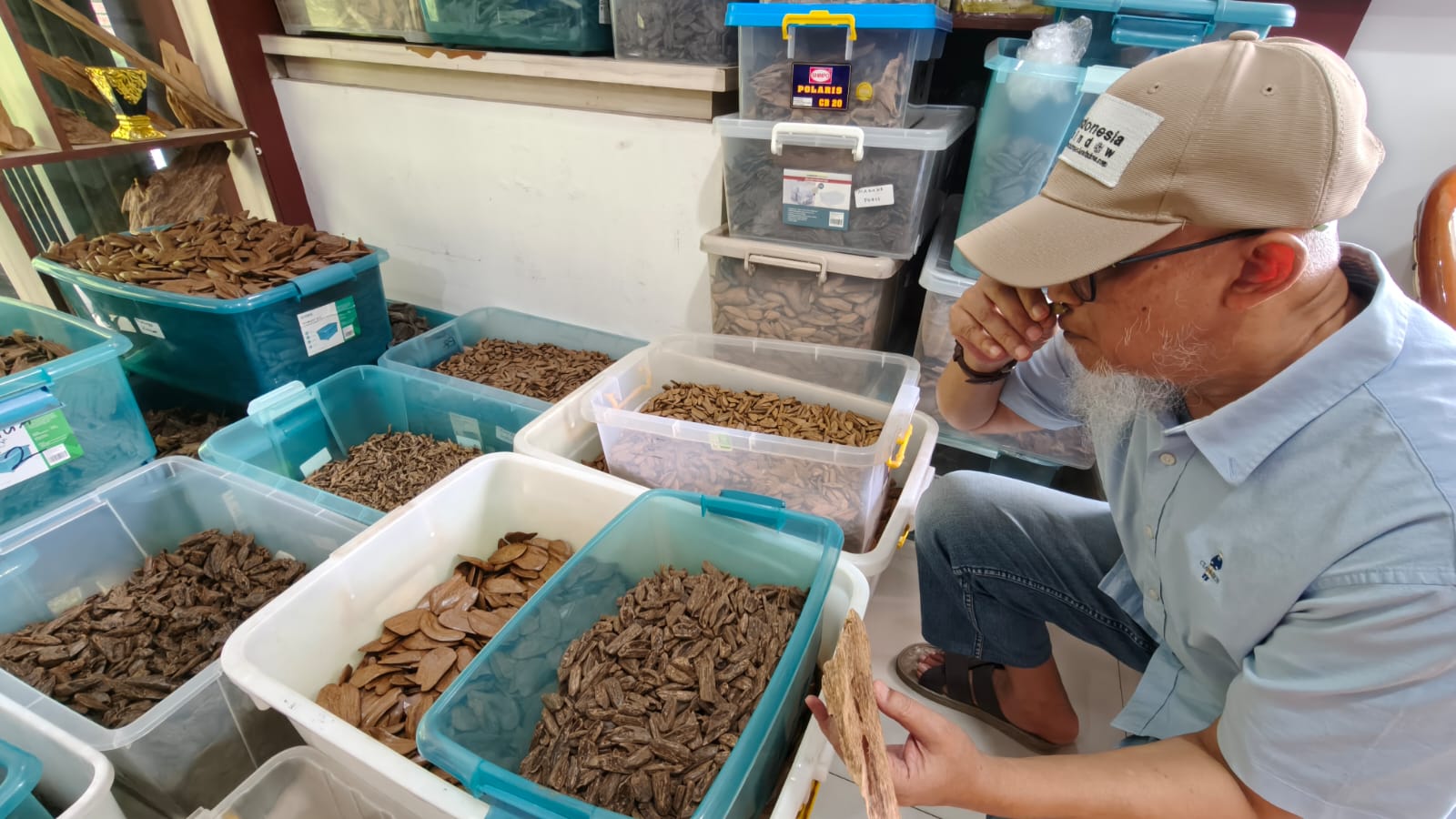
Zaky Al-Habsyi, an Indonesian gaharu businessperson (left), during a special interview with Indonesia Window, at his store, Al Amanah, in Bogor district, West Java province, on Thursday (April 23, 2026). (Indonesia Window/Ronald Rangkayo)
The agarwood trade at Al Amanah is very busy, offering a wide range of varieties originating from across Indonesia—from premium grades to 'third-class' quality—covering both naturally fragrant wood and artificially enhanced products.
Bogor, W Java (Indonesia Window) – Begining with a tree that is 'sick,' infected by fungus, it is harvested only after having dried and shed its leaves, then broken into fragments that seem to have only small values.
Yet from this seemingly unremarkable story, it emerges a rare and luxurious commodity which is even dubbed 'green gold' or 'diamond in the forest.' This is agarwood, prized for its distinctive fragrance.
The scent of agarwood comes from the agar tree (Aquilaria malaccensis) infected by pathogenic fungi, particularly Fusarium species. As a defense mechanism against the invading organism, the tree produces an aromatic resin that transforms healthy wood into high-value resinous heartwood, known as 'gaharu' in Indonesia.
This infection process darkens the wood, enriches its fragrance, and increases its density. It can occur naturally or be induced through artificial inoculation.
Indonesia is the world’s largest producer and exporter of agarwood, supplying around 70 percent of global demand, particularly to Arab countries. The Indonesian agarwood is renowned for its complex, distinctive, and diverse aroma.
“Fragrance is an integral part of Arab culture—it symbolizes social status and respect for guests,” said Zaky Al-Habsyi, an agarwood businessman, during a recent interview at his Al Amanah shop in the Puncak area of Indonesia's Bogor district, West Java province.
He explained that agarwood plays a role in traditional Arab hospitality rituals. A gathering typically begins with coffee (gahwa) and dates. The host then burns agarwood chips in a small handheld burner.
Soon, thin wisps of smoke rise, releasing a rich fragrance that fills the room and lingers on guests’ clothing—a gesture of honor rooted in the tradition of burning agarwood.
Beyond tradition, fragrance also holds a place in Islamic teachings, which encourage men to wear perfume during worship and maintain pleasant scents, as they are believed to be favored by angels.
These cultural and religious practices have made the Middle East the dominant market for agarwood.
“Almost all my buyers are from Arab countries, especially Saudi Arabia. My shop is located in Puncak (tourist area), which is well known among Arab tourists as a cool and relaxing destination,” said Zaky who continues a family business established four decades ago.
At Al Amanah, trade remains lively thanks to the wide selection of agarwood sourced from across Indonesia, ranging from premium to c-class grades. The inventory includes both naturally aromatic wood and products enhanced through oil injection techniques.
“Almost every region in Indonesia produces agarwood. There are more than 20 types with different grades—Sumatra, Banten, Sulawesi, and Seram Island in Maluku,” he noted, adding that varieties from Malinau town in North Kalimantan province and Merauke City in Papua province are currently in high demand.
In general, agarwood grading is determined by two main factors: the quality of its aroma when burned and the duration of combustion before it turns to charcoal.
“Scent is subjective, but most Arab buyers favor these two types. High-grade agarwood burns longer—up to 10 minutes—and its fragrance lasts longer. That’s because of its high oil content,” Zaky explained.
At Al Amanah, this 'green gold' is priced between 60 million and 100 million rupiahs per kilogram. In broader markets, prices can reach billions of rupiahs.
“There’s no fixed pricing for agarwood. If buyers truly like the scent, they won’t hesitate to offer very high prices,” he said.
With abundant natural supply, extraordinary value, and relatively stable demand, the agarwood business remains highly lucrative.
“However, entering this business requires years of experience. It’s not something you can master in one or two years. You need to learn how to identify types and quality from different regions, and build trust with both buyers and suppliers,” Zaky noted.
Amid ongoing geopolitical tensions in the Arab region, he acknowledged that sales at his shop have declined somewhat.
“We’re facing difficulties shipping to Arab countries. Tourist arrivals from the region have also dropped due to the impact of war,” he said.
Fortunately, agarwood stock does not expire.
“The older the wood has, the drier it becomes—and that’s actually better because the oil content intensifies. In other words, the longer it’s stored, the more valuable it becomes,” Zaky added.
Reported by Indonesia Window
Bagikan

Komentar
Berita Terkait
Indonesia’s government supports local herbal medicines going global
Indonesia
•
28 Jul 2025

Indonesia to issue new regulation on electricity tariffs from renewable energy
Indonesia
•
15 Sep 2020
Indonesia to utilize 166 million tons of domestic coal in 2022
Indonesia
•
27 Jan 2022

China, U.S. hold candid, in-depth, constructive talks on economic, trade issues
Indonesia
•
17 Mar 2026


Berita Terbaru
Opinion – An Asia-Pacific Community: Our shared choice for regional prosperity
Indonesia
•
09 Sep 2026

China's EV charging infrastructure expands rapidly in first seven months
Indonesia
•
26 Aug 2026

China-Ecuador ties get a boost as Xi Jinping pushes Belt and road, AI Cooperation
Indonesia
•
19 Aug 2026

Hainan steps up efforts to build world-class tourism, consumption destination
Indonesia
•
16 Aug 2026