Feature – Asep Jembar, environmentalist ‘charcoal maker’ who started business with devotion

28 September 2025
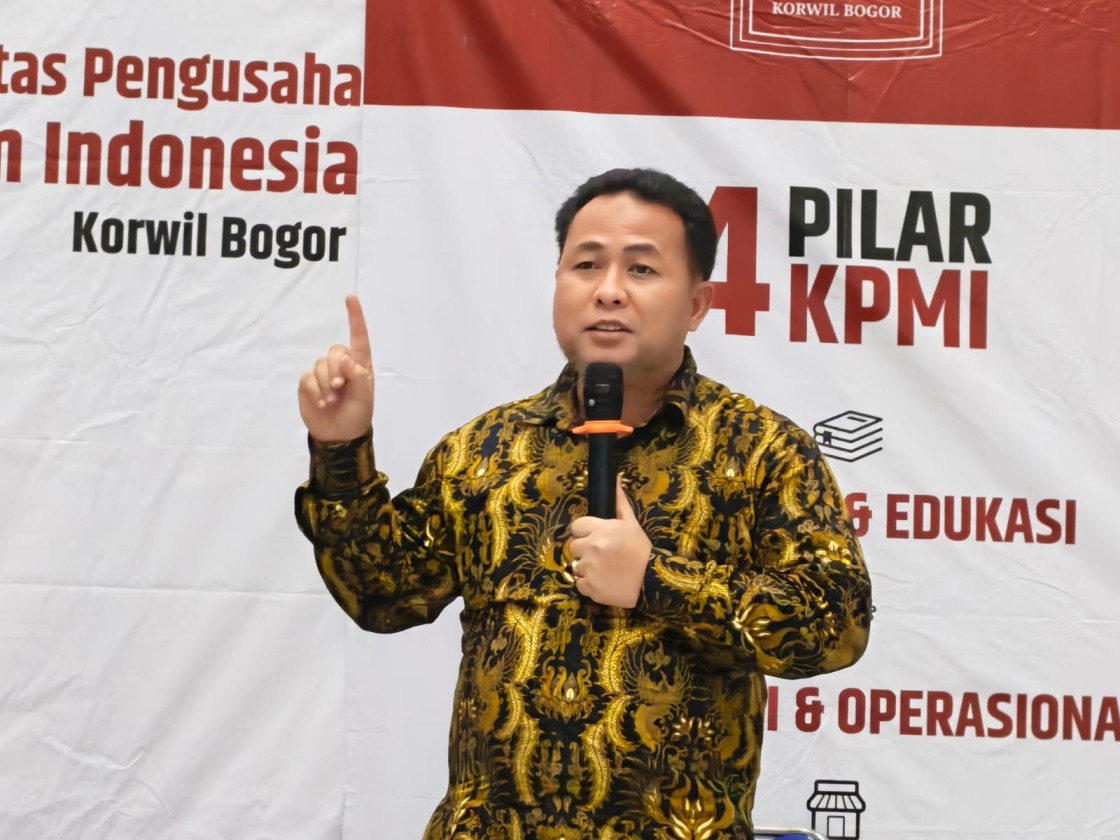
The owner of House of Charcoal, Asep Jembar Mulyana, shared his stories at a business talk held by the Indonesian Muslim Entrepreneurs Community (locally known as its abbreviation KPMI) of Bogor region, at Vivo Mall, Bogor, West Java province, on Friday (September 26, 2025). (Indonesia Window)
House of Charcoal, Asep's premium coconut shell briquettes, has distributed its products worldwide as the number of buyers is growing.
Bogor, W Java (Indonesia Window) – ‘Asep the charcoal man.’ That's how Asep Jembar Mulyana introduces himself.Charcoal has been a part of the Sukabumi-based entrepreneur's life for the past 27 years. Under the brand name, House of Charcoal, Asep's premium coconut shell briquettes have been distributed worldwide as the number of buyers is growing in the world.Asep is now not just selling, but also intensively running ‘the Save the World by Coconut Charcoal’ campaign to raise awareness about environmental protection.The business success and life path of the Chairman of the Indonesian Coconut Charcoal Briquette Entrepreneurs Association (locally known as its abbreviation HIPBAKI) are the true embodiment of the adage ‘from hero to zero’.Poverty was the starting point for Asep to forge himself into a person who never gives up. He is consistent, and most importantly, he says, "always relies solely on Allah (ﷻ).""I've had my fair share of poverty and hunger. I was so poor as a child that I often ate rice doused with hot water and sprinkled with salt," he recalled during a sharing session at the Bogor Regional Coordination Meeting of the Indonesian Muslim Entrepreneurs Community (locally known as its abbreviation KPMI) at Vivo Mall, Bogor, on Friday (Sep 26).Born into a poor family, Asep has been a farmer since junior high school, when he and his parents migrated to a transmigration area in Indonesia’s Palembang city, South Sumatra province, a five-hour journey by speedboat, he explained.The hardships forced him to find a way to survive. From Palembang, young Asep bravely made his way to Jakarta, even though he had to work as a street vendor and bus driver.With only a small amount of money saved from various jobs, Asep and his parents could only afford to live in a house made of used cardboard on the banks of the Manggarai River in Central Jakarta.Even so, their determination to escape the cycle of poverty never wavered."Long story short, I finally got jobs at large companies like the Salim Group and Astra. I was even sent abroad," he said.However, the turning point in Asep's life came when he returned to the Quran and the Sunnah."I did hijra. But my hijra (migration) wasn't just about worship, but also about a way of thinking and doing business. If we pursue this world, the afterlife will escape us. But if we pursue the afterlife, this world will chase us until we're overwhelmed," he said.Since 1998, Asep has chosen his path as a coconut shell charcoal entrepreneur. For him, this is not just a business, but a campaign to save the environment.“I'm not selling a product, but selling an environmental campaign. Coconut shell charcoal is more environmentally friendly than wood charcoal," he explained.Despite having a worldwide network of buyers, Asep never participated in exhibitions or actively promoted his products. Oddly, he keeps receive invitations to speak at various international forums.One of the most memorable moments was when he first spoke on the environment before the Papua New Guinean parliament, along with other world experts."Frankly, I was crazily shaking. I had mastered the material, but I wasn't fluent in English, while there were experts and officials from the Papua New Guinean parliament in front of me," he recalled, adding that he received thunderous applause and firm handshakes after his speech.For Asep, the key to success is not just doing business strategy, but also the extent of one's faith in God's promises. "Do business with Allah, because Allah has guaranteed our success," he asserted.He also emphasized the importance of piety by observing the five obligatory prayers on time, practicing the sunnah (advance worship), and conducting business according to Islamic principles.Asep is now earning the rewards of his hard works despite years of poverty. Charcoal—a black, dirty thing that people continually seek—is a ‘brand’ associated with Asep Jembar Mulyana.However, for him, the true branding lies not in products or popularity, but in Allah (ﷻ)."A good attitude and piety are the main assets," he concluded.Reporting by Indonesia WindowBagikan
Komentar
Berita Terkait
President optimistic Indonesia's economy to grow by 8 percent
Indonesia
•
17 Jan 2025

Indonesia applies smart grids to achieve national energy mix
Indonesia
•
24 Sep 2020
Indonesia expands capital access for MSMEs
Indonesia
•
21 Aug 2025

Indonesia's trade balance in January 2022 books surplus of 930 mln USD
Indonesia
•
16 Feb 2022
Berita Terbaru
Indonesian president meets 12 Global CEOs in Washington, D.C.
Indonesia
•
22 Feb 2026
Indonesian President, British PM agree on New Indonesia-UK Strategic Partnership
Indonesia
•
21 Jan 2026
Algeria, Indonesia sign MoU to strengthen cooperation in phosphate sector
Indonesia
•
21 Jan 2026
Indonesia emphasizes private sector’s strategic role in accelerating accession process to OECD
Indonesia
•
20 Jan 2026