Indonesia’s karst in districts of Maros, Pangkep holds 75 percent of the country’s rock art

14 July 2025
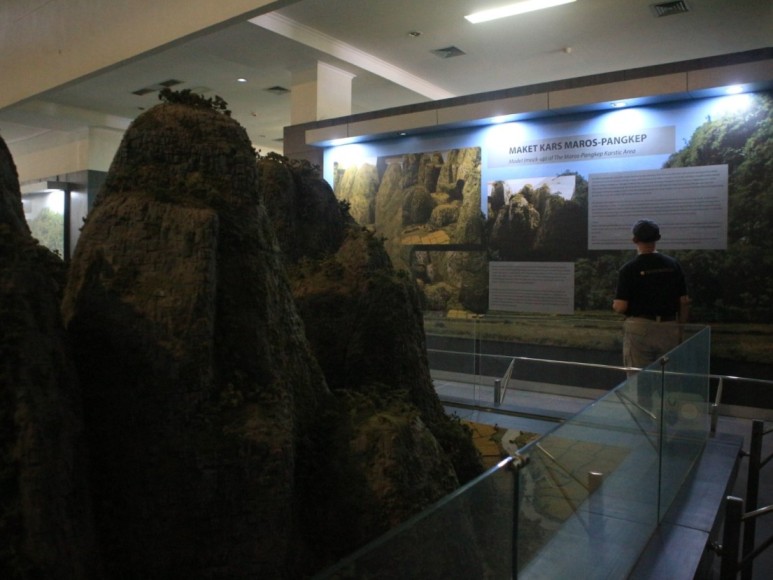
A visitor was observing a model of the Maros-Pangkep Karst at the Indonesian Karst Museum in Indonesia’s Wonogiri district, Central Java province, on June 12, 2025. (Indonesia Window)
The karst area in districts of Maros and Pangkep in Indonesia’s South Sulawesi Province is home to the most ancient rock art in the country.
Bogor, West Java (Indonesia Window) – Archaeological research from the Archaeometric Research Center of Indonesia’s National Research and Innovation Agency (locally known as its abbreviation BRIN) in the karst area of Maros-Pangkep in South Sulawesi Province shows that the location holds the most ancient rock art in the country.Of all the rock art discovered in Indonesia, 75 percent have been found in thes area, according to Adhi Agus Oktaviana, a researcher at the BRIN’s Archaeometric Research Center.“This region is the most diverse and complex in understanding many aspects of prehistoric human life and its transformations. This is especially true of ancient art, which serves as a visual depiction of the history of art and human knowledge," Adhi stated in his presentation at the 2025 Gau Maraja International Conference on ‘Leang-Leang Maros as the Gateway to Ancient Humans in the World" in Maros on Saturday (July 5), as quoted from the BRIN website on Monday.Leang Karampuang depicts handprints, large pigs, piglets with offspring, small pigs, and anoa heads, he said, adding that of these, the most interesting is the 51,200-year-old depiction of a group of pigs and deer.There are distinctive patterns in the rock art in South Sulawesi, namely handprints with pointed fingers. These patterns are not only found in Maros and Pangkep but also spread throughout Southeast Sulawesi. "The distribution of drawings resembling pointed fingers can indicate migration patterns," Adhi explained.Substantively, the Head of BRIN’s Research Center for Historical Archaeology and Prehistory, Muhammad Irfan Mahmud, pointed out that the paintings found at the Maros Pangkep site are an encyclopedia of knowledge.All paintings are a historical encyclopedia containing knowledge from ancient peoples. For example, the drawings at cave sites represent encyclopedic knowledge. Don't assume that prehistoric people simply lived in caves and lived simply foraging for food and consumption. They naturally had a thinking process, starting from a simple level," Irfan said..A case study at Leang Tianang in Maros showed that the flora and fauna images at the site are bio-indicators with ecological value, he noted, explaining that the visualization of the flora and fauna motifs at the site is not merely a mythical depiction, but also contains symbolic ecological knowledge."The visualization of the motifs reflects the cosmology of the underworld, namely aquatic fauna. The boat represents the human world, while the nipah (nypa fruiticans) represents the upper world (spirit), which the Bugis (a tribe in Sulawesi) call the tori langit (sky). For coastal residents, the nipah represents the cosmographic boundary sky, while the nipah shoot represents growth, fertility, and rebirth," Irfan Mahmud said.Reporting by Indonesia WindowBagikan

Komentar
Berita Terkait

Opinion – Digital-driven healthcare transformation: a new chapter of holistic care in Taiwan
Indonesia
•
19 May 2026

At least 824 million people worldwide malnourished by end of 2020: U.N.
Indonesia
•
17 Oct 2020

COVID-19 – Pandemic increases global child mortality: WHO
Indonesia
•
09 Sep 2020

Two million pilgrims register for umrah in one month
Indonesia
•
08 Nov 2020


Berita Terbaru

Feature – From barefoot to high-tech: How Chinese doctors shaped a healthier nation
Indonesia
•
23 Aug 2026

Feature – Paddling, camping, birdwatching: How a greener China reshapes urban getaways, lifestyles
Indonesia
•
17 Aug 2026
The rain, the caves and the quest to preserve Mogao Grottoes
Indonesia
•
16 Aug 2026

China aims to elevate basic education with focus on virtue, health and equity
Indonesia
•
29 Jul 2026