China's tourism boom blends culture, innovation and livelihoods

22 May 2026
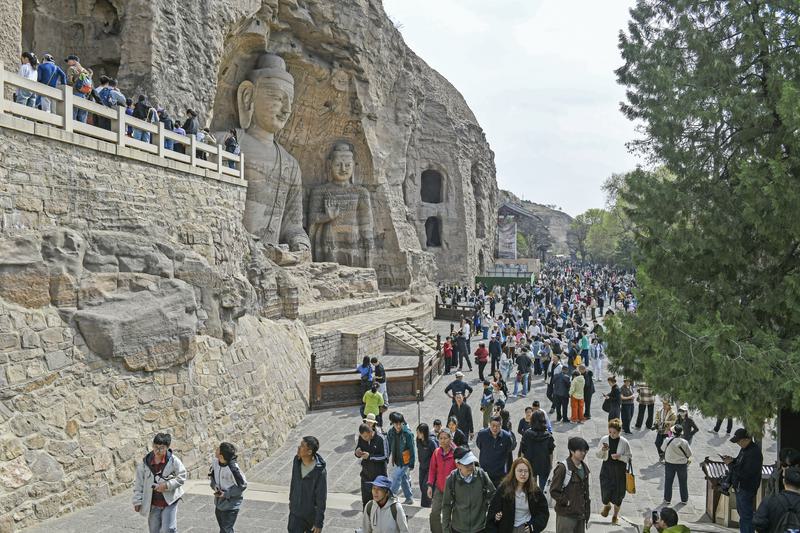
This photo taken on May 3, 2026, showed tourists walking at the Yungang Caves tourist attraction in Datong City, north China's Shanxi Province. (Xinhua)
Beijing, China (Xinhua/Indonesia Window) – Visitors touring the Longmen Grottoes in central China's Henan Province often discover more than stone carvings, murals and statues, encountering instead a timeless story of creativity, faith, craftsmanship and cultural exchange among civilizations.
This UNESCO World Heritage Site boasts a history spanning over 1,500 years, with a total of 2,345 caves and niches carved into the steep cliffs that stretch more than 1 km. During this year's May Day holiday, it received 344,000 tourists.
From 2012 to 2025, the number of trips made by Chinese people increased by 1.2 times, while tourism spending rose 1.77 times. In 2024, the added value of tourism and related industries accounted for 4.35 percent of China's gross domestic product (GDP).
Meanwhile, the needs of travelers are also changing. Many people are no longer satisfied with brief sightseeing. They are willing to pay for performances, queue for trendy toys, travel for local specialties and spend more time understanding the life and culture of a destination.
"Chinese travelers' needs are constantly evolving, and this will continue to fuel our service innovation," said Wendy Huang, senior vice president and commercial director with Hilton Greater China & Mongolia.
Tourism gains steam
From museum tours, intangible cultural heritage to red tourism and educational trips, culture-themed travel has become increasingly popular.
In 2025, inbound tourist visits surpassed 150 million, an increase of 17.1 percent.
Many of them have a tremendous interest in Chinese culture. Chai Qilin, deputy head of the cultural promotion department at the Dunhuang Academy, said overseas audiences have shown strong interest in Chinese cultural exhibitions. "Many visitors tell us they hope to see more exhibitions like these," Chai said. "Through them, people gain a more direct and deeper understanding of Chinese culture."
From a once relatively small and weak sector, China has become the world's largest source of outbound tourists and a major international tourist destination, forming a distinctive path of tourism development.
Tourism is a comprehensive industry. Its value is increasingly seen not only in ticket sales but also in its ability to drive the growth of other sectors.
For instance, in east China's Jiangsu Province, the 2026 provincial city football league provides an example of how sports and tourism can reinforce each other.
During the first round of the league, A-level tourist attractions in four host cities received 2.45 million tourist visits, up 1.41 percent year on year. Among them, 1.44 million visits were made by tourists from outside the host cities, up 1.53 percent.
Data also shows that every 1 yuan in ticket revenue from the football league drove 7.3 yuan in related consumption last year.
The outline of China's 15th Five-Year Plan, released in March, calls for expanding cultural, sports and tourism consumption, while creating more immersive and interactive consumption experiences to unleash the potential of the service sector further.
Tourism promotes quality
China's tourism industry is also moving toward higher quality with buzzing technologies. Digital technology, artificial intelligence and advanced manufacturing are being applied to tourism, giving rise to smarter services and new travel experiences.
In Beijing's Yizhuang district, the Xiaomi automobile factory has become a new industrial tourism destination.
Freya Zhang, a research analyst at the investment consulting firm Tech Buzz China, told the journal Wired that China's EV factory tour "offers a chance to not only see the production line up close, but also experience the human side of the brand."
Ever since regular visits began more than a year ago, the factory has received nearly 200,000 visitors, including visits from business delegations, university study groups and ordinary tourists.
China is working to upgrade scenic areas, improve tourist resorts, develop leisure vacation products, and create more distinctive travel routes.
The 2026 China Tourism Day theme-month activities are being held nationwide, with emphasis on inbound tourism, travel safety and consumption. Local authorities plan to introduce more than 9,000 measures and provide over 1 billion yuan in subsidies and discounts.
From ancient grottoes to rural villages, from ice-and-snow destinations to factory tours, China's tourism story is no longer just about where people go. It is increasingly about how travel connects culture, livelihoods, innovation and development.
Reporting by Indonesia Window
Bagikan

Komentar
Berita Terkait

China to buy 200 million tonnes of Indonesian coal in 2021
Indonesia
•
27 Nov 2020

Freeport turns to underground mining in 2020-2023
Indonesia
•
22 Dec 2019

Indonesia maximizes processed-nickel in downstream industry
Indonesia
•
14 Oct 2020

Café becomes Generation Z’s lifestyle, giving great opportunity to Indonesia
Indonesia
•
23 Nov 2021


Berita Terbaru
Opinion – An Asia-Pacific Community: Our shared choice for regional prosperity
Indonesia
•
09 Sep 2026
China's EV charging infrastructure expands rapidly in first seven months
Indonesia
•
26 Aug 2026
China-Ecuador ties get a boost as Xi Jinping pushes Belt and road, AI Cooperation
Indonesia
•
19 Aug 2026
Hainan steps up efforts to build world-class tourism, consumption destination
Indonesia
•
16 Aug 2026