China's economy maintains steady recovery momentum with strong vitality, resilience

20 May 2026

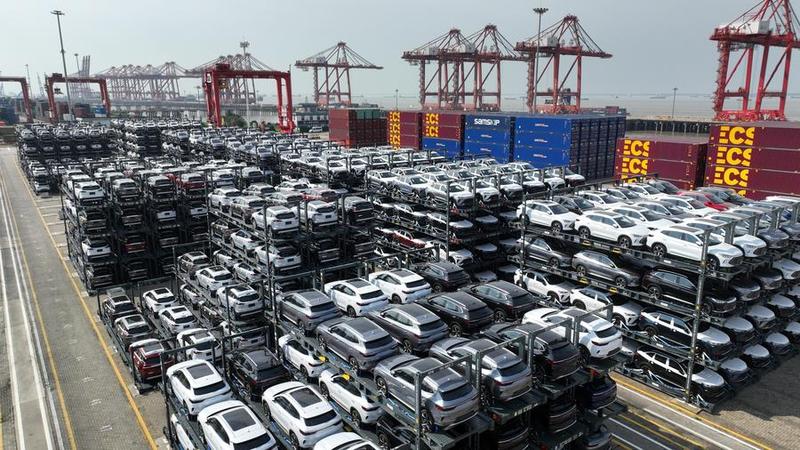
An aerial drone photo taken on May 17, 2026 shows a view of the Longtan Container Terminal at Nanjing Port, east China's Jiangsu Province. (Photo by Yang Suping/Xinhua)
Beijing, China (Xinhua/Indonesia Window) - China's economy posted a steady recovery in the first four months of 2026, with key indicators rebounding and new growth drivers gaining momentum as macroeconomic policies continued to take effect.
During the January-April period, growth in production and supply accelerated, while market demand continued to expand. Employment and consumer prices also remained generally stable, according to data released Monday by the National Bureau of Statistics (NBS).
Amid a complex international landscape, China has adopted a more proactive fiscal policy and an appropriately accommodative monetary policy to support the economy's continued upgrading and optimization, demonstrating strong resilience and vitality, NBS spokesperson Fu Linghui said at a press conference.
According to NBS data, the country's value-added industrial output increased by 5.6 percent year on year in the first four months of 2026. In April alone, industrial output grew 4.1 percent year on year, and rose 0.05 percent compared to the previous month.
Despite the impact of geopolitical tensions in the Middle East and heightened volatility in global energy markets, China's industrial output has remained generally stable, continued its transformation and upgrading, and demonstrated strong resilience, Fu said.
Fu attributed the industrial sector's steady performance to China's comprehensive industrial system and strong supporting capabilities, as well as to policy support for the domestic green energy transition.
Consumption continued to recover, as retail sales of consumer goods - a key indicator of consumer spending - grew 1.9 percent year on year in the first four months, NBS data showed.
The upturn was in line with data released earlier this month, which showed that China's consumer price index, a main gauge of inflation, rose 1.2 percent year on year in April, up 0.2 percentage points from the previous month.
Commenting on the upward trend in the consumer market, Fu said that China is well-positioned to further expand consumption, citing its super-large market and diverse consumption scenarios. With multiple pro-consumption measures continuing to take effect, the country is expected to sustain steady growth in consumer spending, Fu added.
Also on the domestic demand front, the country's fixed-asset investment dropped 1.6 percent year on year in the first four months, but a breakdown showed that infrastructure investment grew 4.3 percent year on year, while manufacturing investment increased 1.2 percent over the same period last year.
Employment remained stable overall, with the country's surveyed urban unemployment rate at 5.2 percent in April, 0.2 percentage points lower than the previous month. The rate averaged 5.3 percent in the first four months of the year.
NBS data also pointed to an upturn in China's property market. In April, prices of commercial homes in first-tier cities rose month on month among 70 large and medium-sized cities, while the month-on-month decline in second- and third-tier cities either narrowed or remained unchanged from the previous month.
Looking ahead, NBS spokesperson Wang Guanhua said that while recognizing the internal and external pressures and challenges affecting economic performance, it is equally important to note that the fundamental drivers of stable and sound growth remain unchanged and are expected to continue to provide support.
"We have opportunities for industrial upgrading driven by the development of new quality productive forces, vitality unleashed by further deepening reforms across the board, and ample policy reserves and preparedness to cope with risks and challenges," Wang said, adding that such factors provide a solid foundation and favorable conditions for sustaining stable and sound economic development.
Overall, China's macroeconomic policy toolkit is diverse, with ample measures and sufficient room for both counter-cyclical and cross-cyclical adjustments, Wang said. "In the next stage, we will make full use of our macroeconomic policy and ensure more targeted, precise implementation, in a bid to foster stronger endogenous driving forces for economic growth."
Reporting by Indonesia Window
Bagikan

Komentar
Berita Terkait

China moves to bolster youth employment for the AI era
Indonesia
•
14 Jul 2026
Labeling China's NEV exports as result of overcapacity can't hold water: officials
Indonesia
•
21 May 2024

As many mas 571,333 expats quit Saudi job market in a year
Indonesia
•
24 Sep 2021

Indonesia's foreign debt in Q2 falls to 403.0 bln USD
Indonesia
•
15 Aug 2022


Berita Terbaru

Feature – Xinjiang's cotton fields nurturing new generation of tech-savvy farmers
Indonesia
•
15 Oct 2026

China's holiday consumption market posts steady growth
Indonesia
•
06 Oct 2026
News Focus – China's high-speed rail network expansion to facilitate cross-city collaboration
Indonesia
•
03 Oct 2026
Opinion – An Asia-Pacific Community: Our shared choice for regional prosperity
Indonesia
•
09 Sep 2026