Islamic study – Zakat agencies should know how to raise funds

19 November 2025
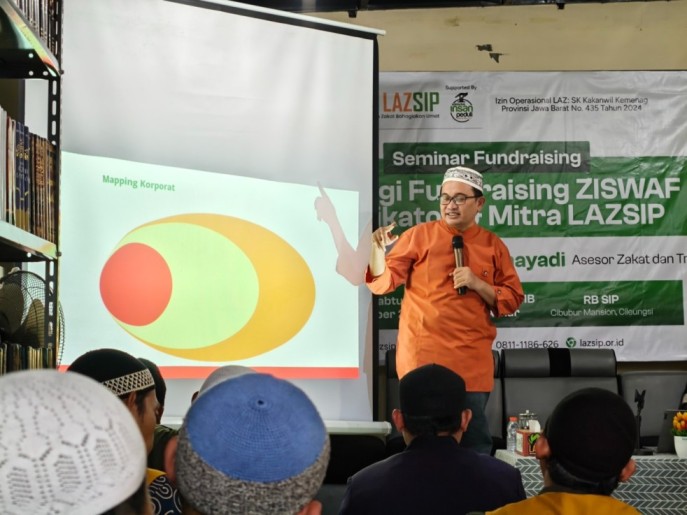
Coach Arif Nurhayadi gave a presentation at a seminar on fundraising organized by Lembaga Amil Zakat Solidaritas Insan Peduli (the Zakat Collection Institution named Solidarity of Caring People (LAZSip) at the LAZSip Rumah Bahagia (Happy House), in Bogor district, West Java province, on November 15, 2025. (Indonesia Window)
A strategy of fundraising, marketing, distributing, financing, and empowering is a measure that must be carried out by zakat agencies.
Bogor, West Jawa (Indonesia Window) – A zakat collecting agency in Indonesia, Lembaga Amil Zakat Solidaritas Insan Peduli (LAZSip), held a seminar on a strategy of fundraising with Coach Arif Nurhayadi at LAZSip's in Bogor district, West Java province, on November 15, 2025.In the seminar, opened by LAZSip Chairman Muhamad Irfandi Lc, Coach Arif Nurhayadi outlined the activities that zakat institutions must undertake a strategy of fundraising, marketing, distributing, financing, and empowering activities.According to Coach Arif Nurhayadi, marketing activities include, literacy and education as well as outreach, essentially introducing zakat law, zakat programs, zakat distribution, and matters related to zakat institutions.Zakat is payment of a certain proportion of personal wealth for charitable and religious purposes, obligatory under Islamic law for every adult Muslim of sufficient means, and it (zakat) is one of the Five Pillars of Islam."This would be extraordinary if we conduct numerous literacy activities with the public/people and donors," Coach Arif said.Arif, who is also a zakat assessor for the Lembaga Sertifikasi Profesi (LSP/ Sharia Professional Certification Institute), explained fundraising activities.Based on the history of zakat in Indonesia, people pay zakat largely because of literacy and education. Therefore, fundraising without zakat literacy and education is usually less successful."Historically, companies, agencies, institutions, and even company leaders have required their employees to pay zakat after they take part in literacy and education activities," Arif said.Arif pointed out that currently, there are two state-owned enterprises that issue decrees requiring all employees to pay zakat, despite the pros and cons."State-owned enterprise Pupuk Kujang in Indonesia’s Cikampek area, West Java province, has a baitul mal (Islamic financial institution), and through this baitul mal, the company offers its employees to pay zakat. However, the State Electricity Company (known as PLN) requires its employees to fulfill this third pillar of Islam," he said.However, according to Arif, company leaders must understand zakat first through literacy and education before they offer or require their employees to pay zakat."And thank God, this is already being implemented in several companies/agencies. I'm sure the LAZSip is doing the same. Literacy and education are important, and the dynamics of differences in Islamic jurisprudence (figh) are inevitable," he explained."We and our fellow assessors who examine zakat collectors fully understand the existence of differences in Islamic jurisprudence (figh). For example, there is one non-government organization in Indonesia that does not recognize profession zakat," he said.Because the government, specifically the National Zakat Agency (locally known as its abbreviation Baznas) and the Indonesian Ulema Council (MUI), use the term ‘profession zakat,’ the assessors used the terminology used by Baznas and MUI."However, when we tested amils (zakat collectors) whose institutions did not have profession zakat, we annulled the question, so it didn't become a mandatory question, because their institutions, based on their Sharia Supervisory Board, do not recognize profession zakat."Arif further said, this is simply a matter of the branches of zakat. "Generally, it's zakat, but there are branches: profession zakat and income zakat. In these institutions, there is income zakat paid annually. "Meanwhile, those who have profession zakat, it (zakat) is paid monthly," he explained.Understanding this fiqh (Islamic jurisprudence) is important, so Arif suggested that zakat institutions should conduct literacy and education on zakat fiqh sustainably.He also observed that social media posts predominantly discuss usury, but the issue of zakat is relatively infrequent. "If you count the number of posts, there are more posts about usury than those about zakat."However, this (zakat post) has increased. As evidenced, our zakat target nationally reached 13 trillion rupiahs for 2025, including that collected by LAZSip, but only nine trillion rupiahs were collected in 2024. This illustrates that this amount is still small, as the potential is 327 trillion rupiahs (according to Baznas)," Arif noted. One USD = 16.745 rupiahs.Baznas collects data on all legal zakat institutions that are required to report every six months.“Back to the business process. After collecting (fundraising) through various means, LAZSip has segmented its target audience. If we target the employee segment, the approach is different from targeting the business segment.“Some time ago, I observed an Islamic high school in Indonesia’s Solo city, Central Java province. The potential ZIS (zakat, infaq, sadaqah) if considered 100 percent, was worth nine billion rupiahs per year, with nearly 1,000 students. Our optimistic potential is 4.5 billion rupiahs, and the realistic potential is 2.25 billion rupiahs. Imagine that the potential of one school is that much,” he noted."Let us see the method of calculating zakat in school, only from parents. In government data, there's a student list. It lists parents, fathers, fathers' incomes, and mothers' incomes,” he said.After accumulating and taking 50 percent of the potential, we found 4.5 billion rupiahs, which was further filtered to find 2.25 billion rupiahs. This means that in that high school, 2.25 billion rupiahs were sitting idle and unutilized.Arif further explained that one way to activate this potential is through literacy and education. "We shouldn't get caught up in differences in Islamic jurisprudence if we're still heterogeneous. But if we're homogeneous and have a common understanding, it would be easier," he added.“If we're still heterogeneous, we'll just use the zakat jurisprudence they use until we provide education similar to the jurisprudence used by the LAZSip’s Sharia Supervisory Board. The practice abroad, due to differences in zakat jurisprudence, ultimately leads to its untapped potential," Arif emphasized.According to Arif, who is also a trainer at the Indonesian Amil School, there are three terms in zakat jurisprudence. The first is nisab, the second is haul, and the third is tarikh.Nisab is the minimum limit of wealth on which a Muslim must pay zakat. Haul is one-year period of ownership of assets which is a condition for zakat. Tarikh is time provision."Now, these serve as parameters, whereas sadaqah and infaq don't have a nisab. People of any income can give sadaqah, but they pay zakat at the minimum of 2.5 percent of their income," he noted.Zakat must then be distributed through amils, the individuals tasked with managing zakat. If not distributed through amils, it is called infaq or sadaqah, he expounded.In LAZSip, as stipulated in Indonesian law, zakat payments are made through mass organizations or foundations. They receive a government decree from the government, and through that decree, managers are appointed.The leaders at LAZSip are those who receive the decree from the foundation which is legally authorized to collect zakat according to the state."I am now talking about zakat and infaq or sadaqah. The dynamics of these differences in society shouldn't be our concern. Our concern is that if someone is obligated to pay zakat based on the nisab, then they should be made aware of their obligation, and then we can discuss the differences in Islamic jurisprudence," he said.According to the Indonesian Ulema Council (locally known as MUI), one of the sharia objectives of zakat is for the mustahik (zakat recipients)."Today, asatidz (teachers) are scrutinizing social media. The topic of discussion is income zakat and professional zakat due to the higher price of gold (2.4 million rupiahs to 2.5 million rupiahs per gram),” he said.Arif pointed out that Baznas has set the nisab for zakat at around one million rupiahs per gram. They have been discussing this issue for almost a year, but there is no further explanation yet."However, I understand it this way. We agreed that the nisab should be used for gold. The question is, if we're talking about the sharia objective only for the muzaki (payer of zakat), this isn't a problem because with the increase in gold prices, the muzaki is not yet obligated to pay zakat because they haven't reached the nisab yet. Meanwhile, the income of the beneficiaries is increasing," he said.Therefore, according to the coach, to overcome this, look for gold that costs one million rupiahs per gram.He suggested that LAZSip promote literacy and education by increasing the number of forums with verifiers and partners on understanding Islamic jurisprudence, led directly by its Sharia Supervisory Board.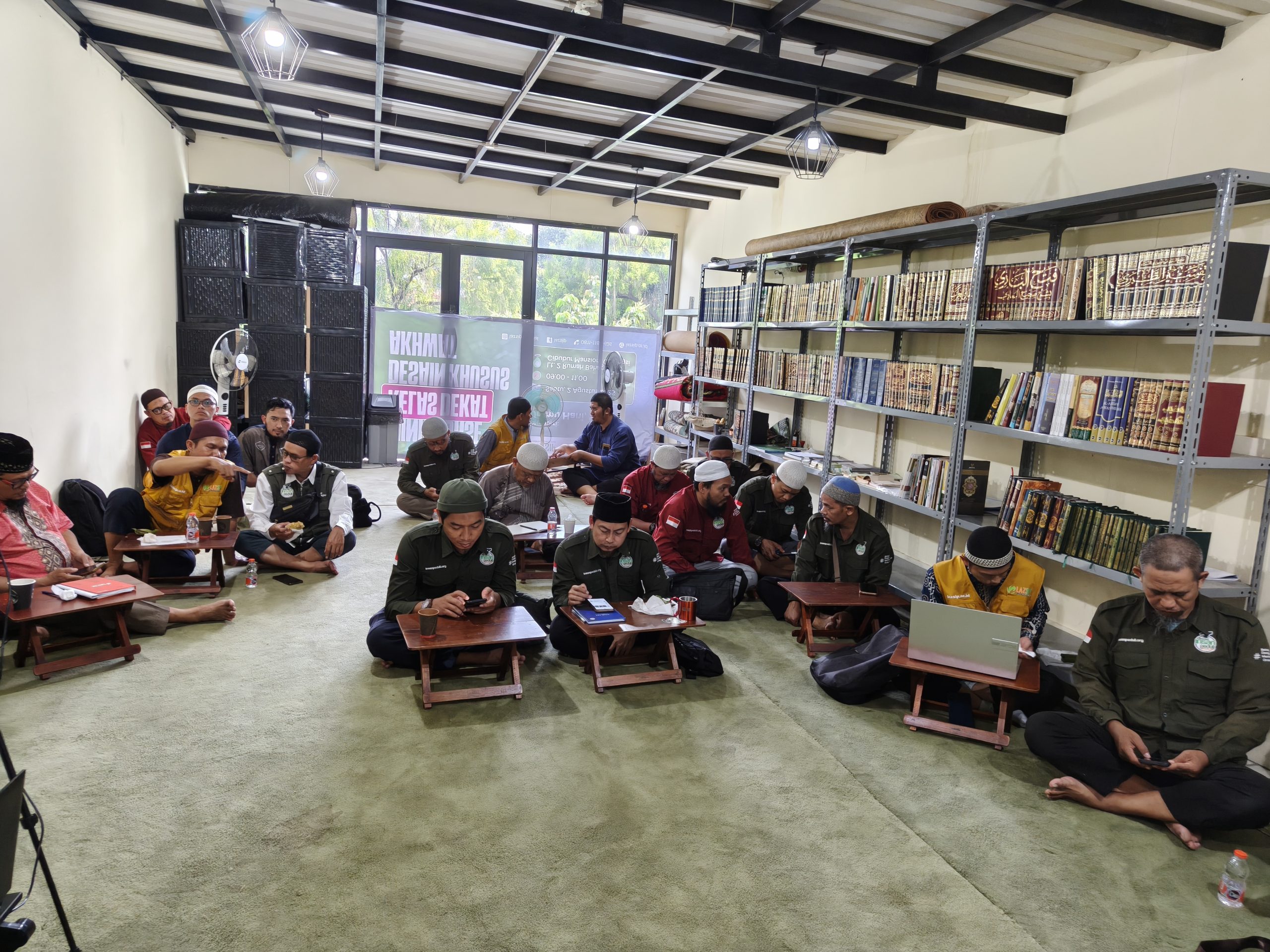
Participants in a fundraising strategy seminar organized by Lembaga Amil Zakat Solidaritas Insan Peduli (the Zakat Collection Institution named Solidarity of Caring People (LAZSip) at LAZSip's Rumah Bahagia (Happy House) in Bogor district, West Java province, on Saturday (November 15, 2025). (Indonesia Window)
Bagikan

Komentar
Berita Terkait

Largest plastic packaging company in Aspac invests initial 7 mln USD in Indonesia
Indonesia
•
26 Jul 2025

Indonesian herbal products penetrate Saudi market
Indonesia
•
11 Aug 2020

Indonesian crude oil in December 2021 falls to 73.36 USD per barrel
Indonesia
•
14 Jan 2022
Indonesia boosts non-oil/gas sector for economic recovery
Indonesia
•
12 Feb 2021


Berita Terbaru
Opinion – An Asia-Pacific Community: Our shared choice for regional prosperity
Indonesia
•
09 Sep 2026

China's EV charging infrastructure expands rapidly in first seven months
Indonesia
•
26 Aug 2026

China-Ecuador ties get a boost as Xi Jinping pushes Belt and road, AI Cooperation
Indonesia
•
19 Aug 2026

Hainan steps up efforts to build world-class tourism, consumption destination
Indonesia
•
16 Aug 2026